
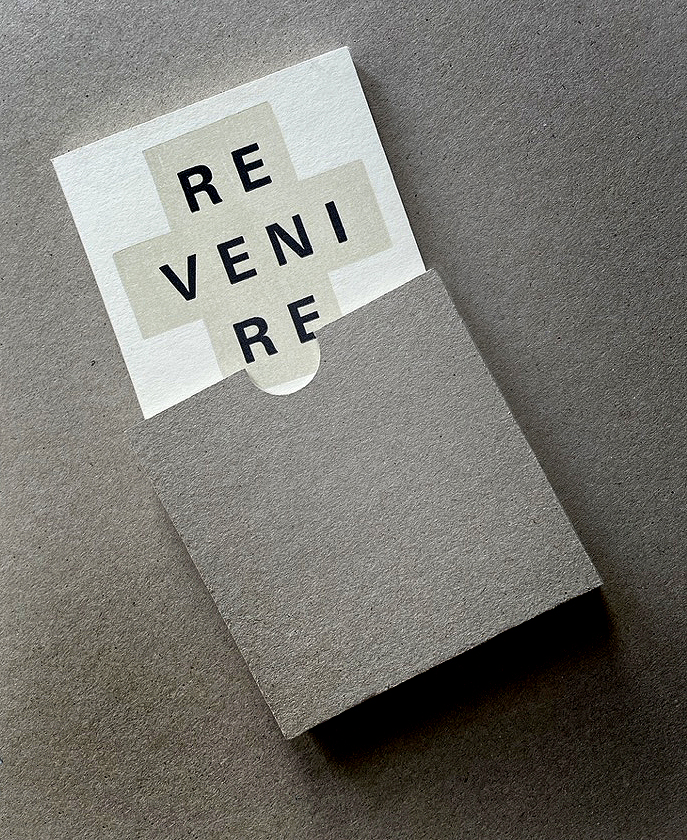
2025
RE VENI RE [trans. from Romanian] means “returning”. The book contains poetic texts by Maria Stadnicka based on interviews conducted with Romanian migrants for her PhD research into transgenerational trauma transmission.
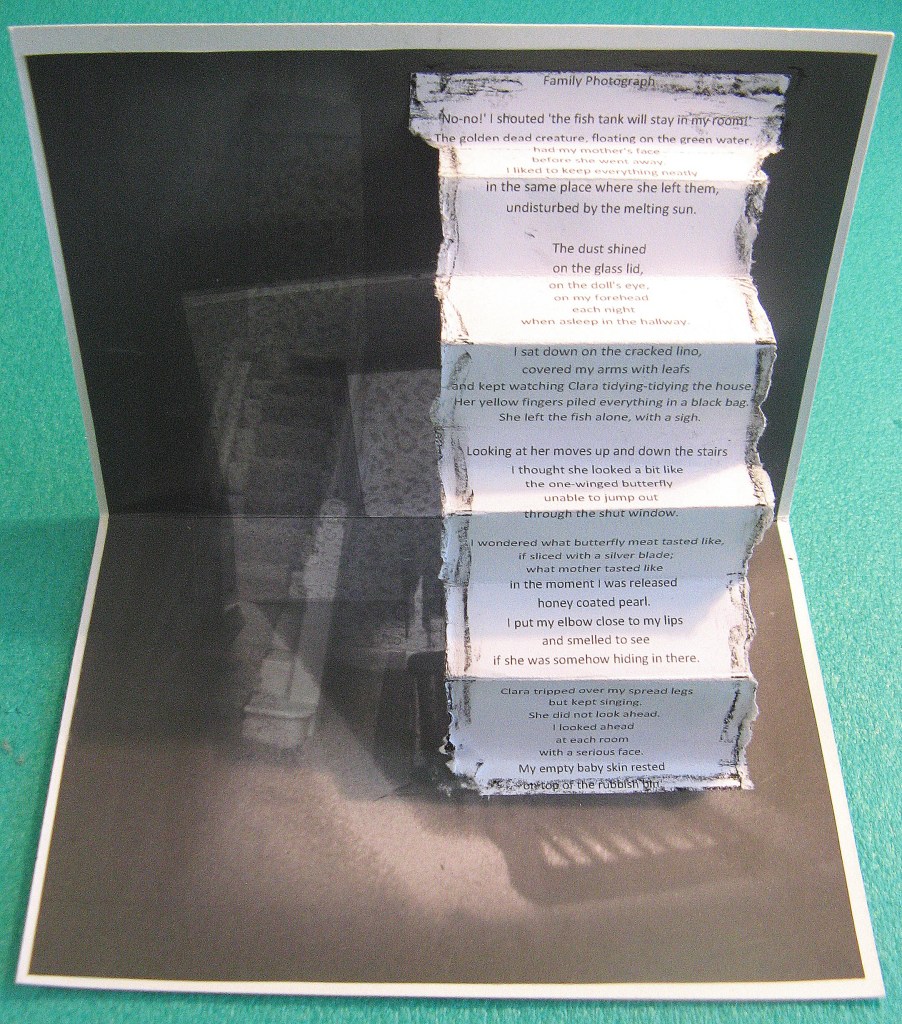
Letterpress printed by the book artist Andrew Morrison, the limited edition book was published on the occasion of the “Enfolded Journeys” touring exhibition taking place in various art galleries across England, Scotland and Italy, 2025-2026.
Publisher: Kerbstone Press, Gloucestershire, UK.

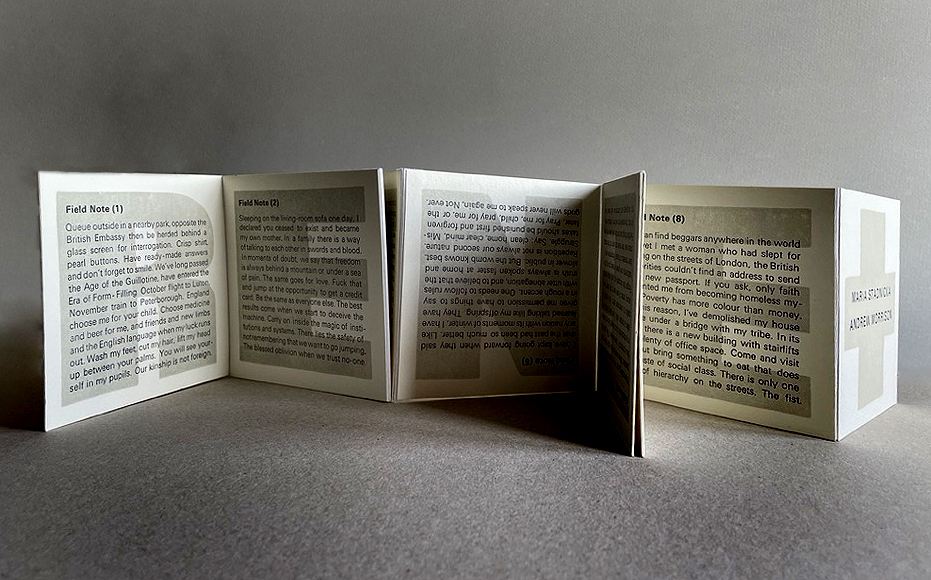
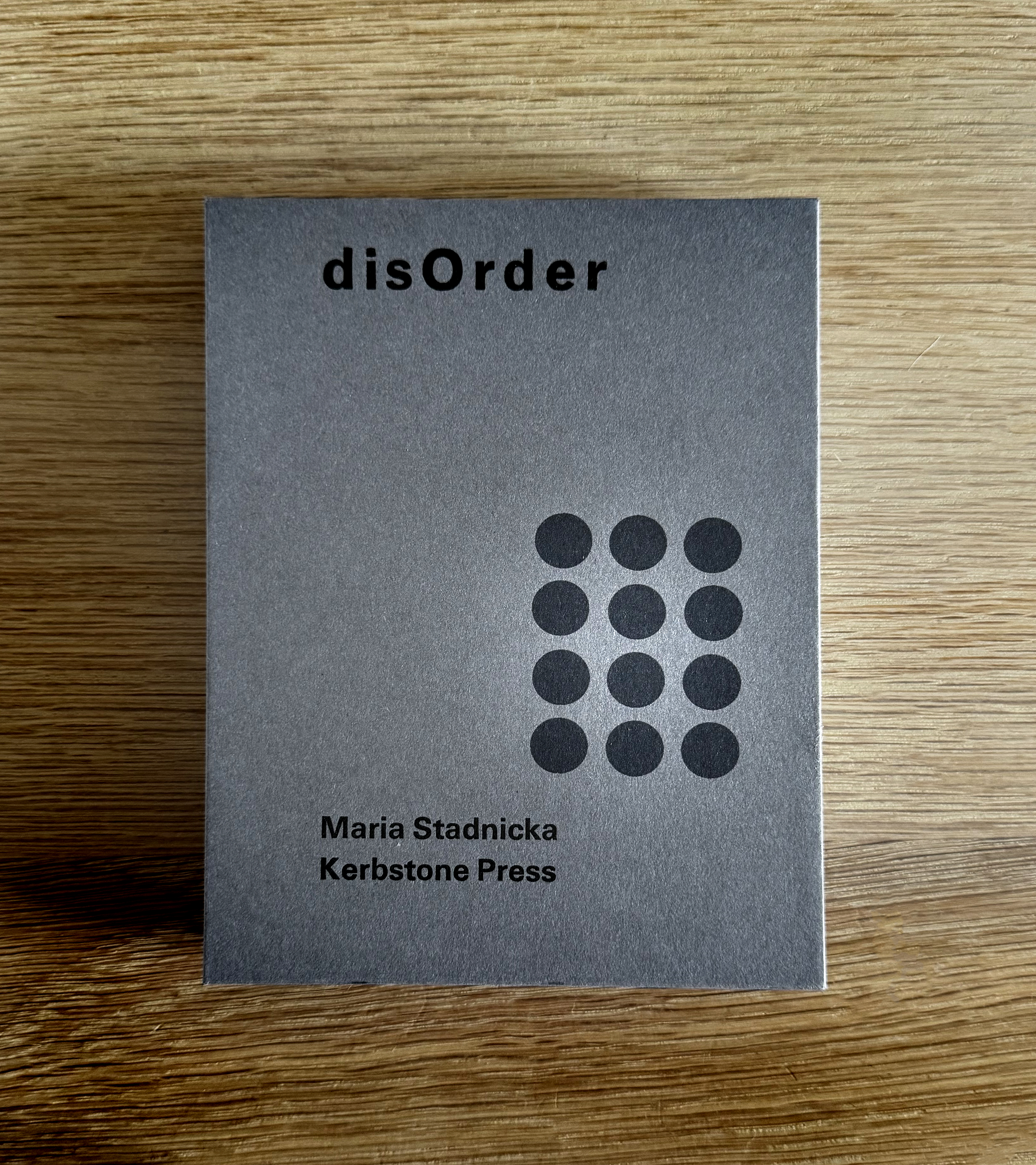
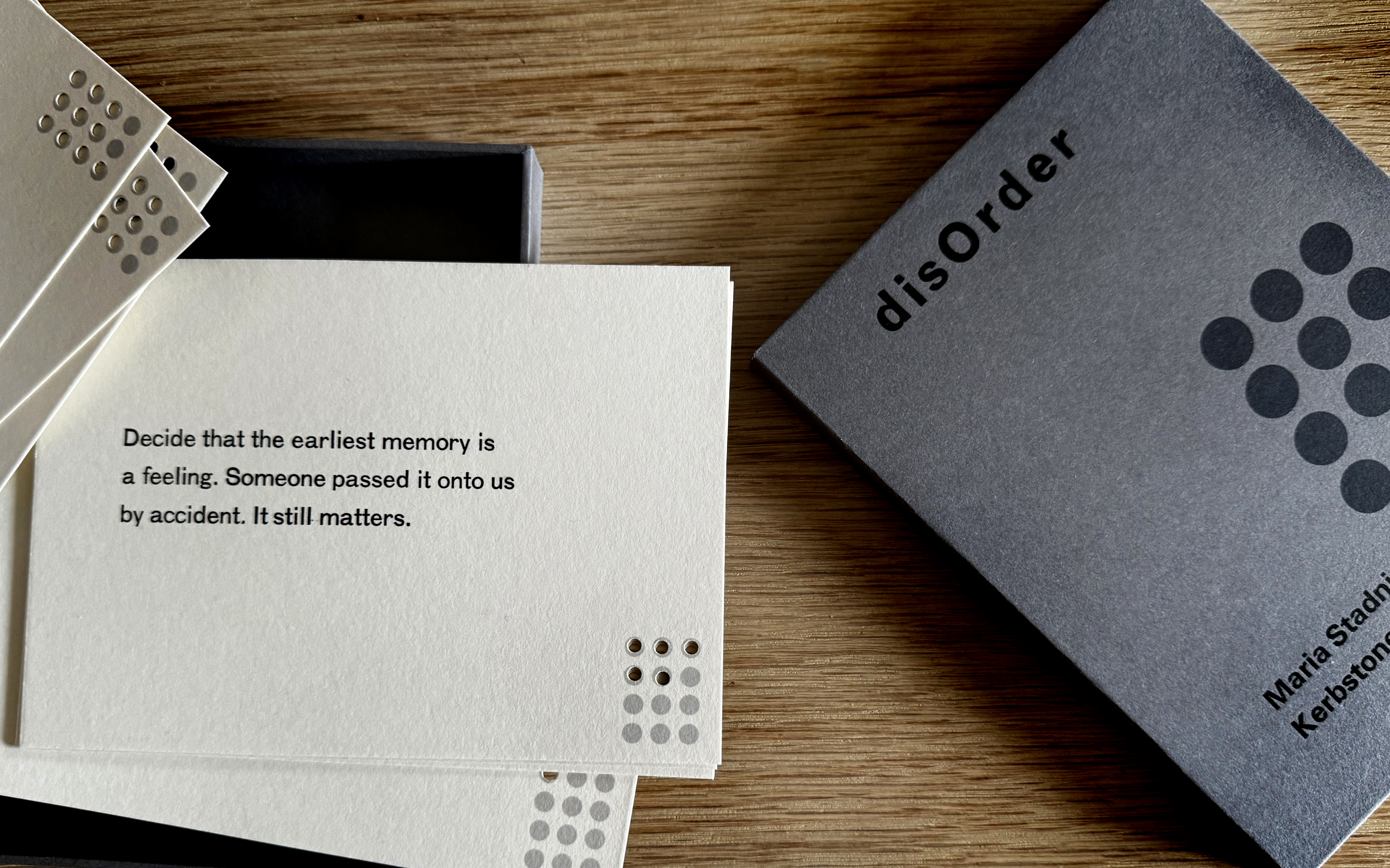
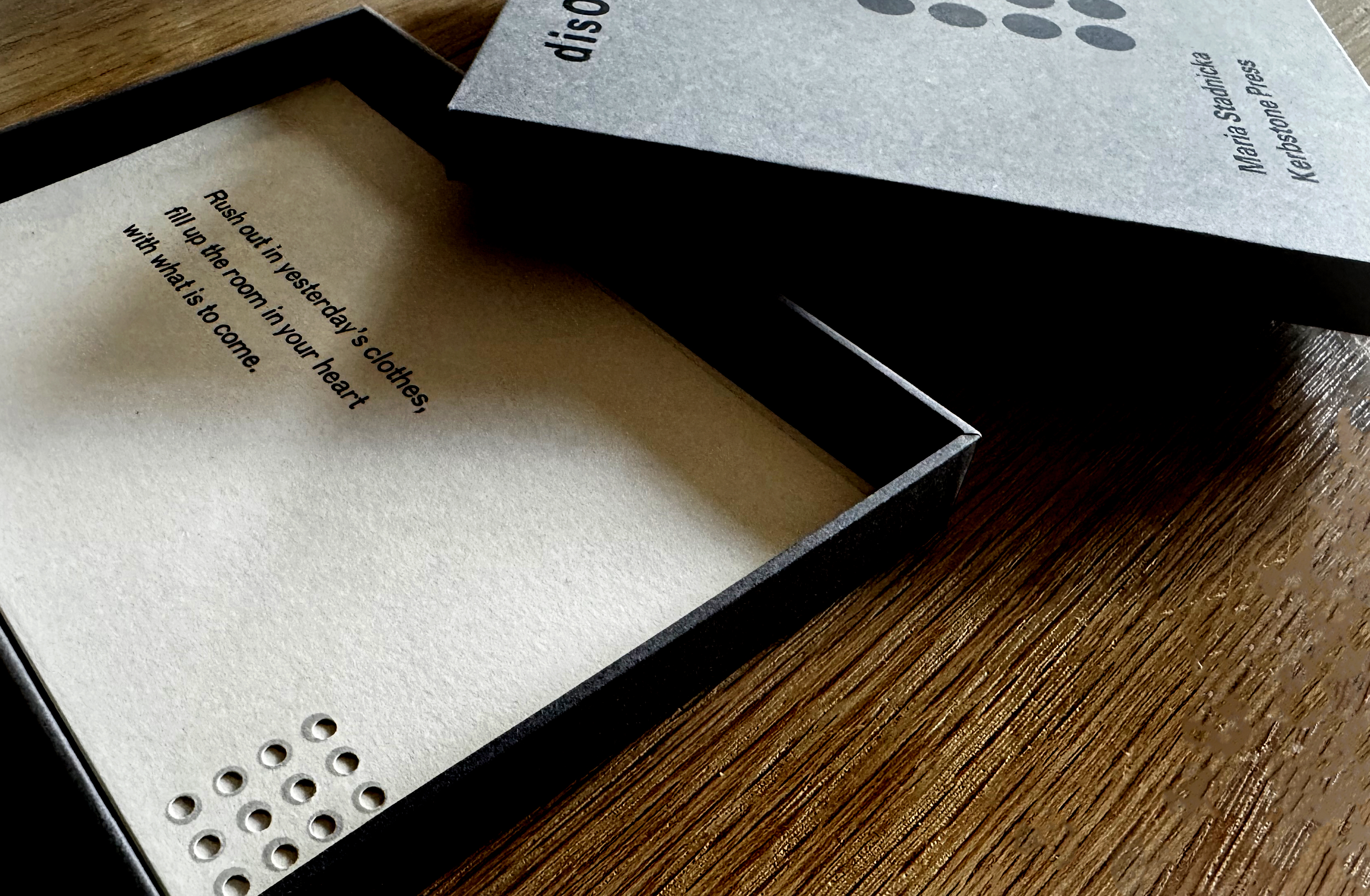
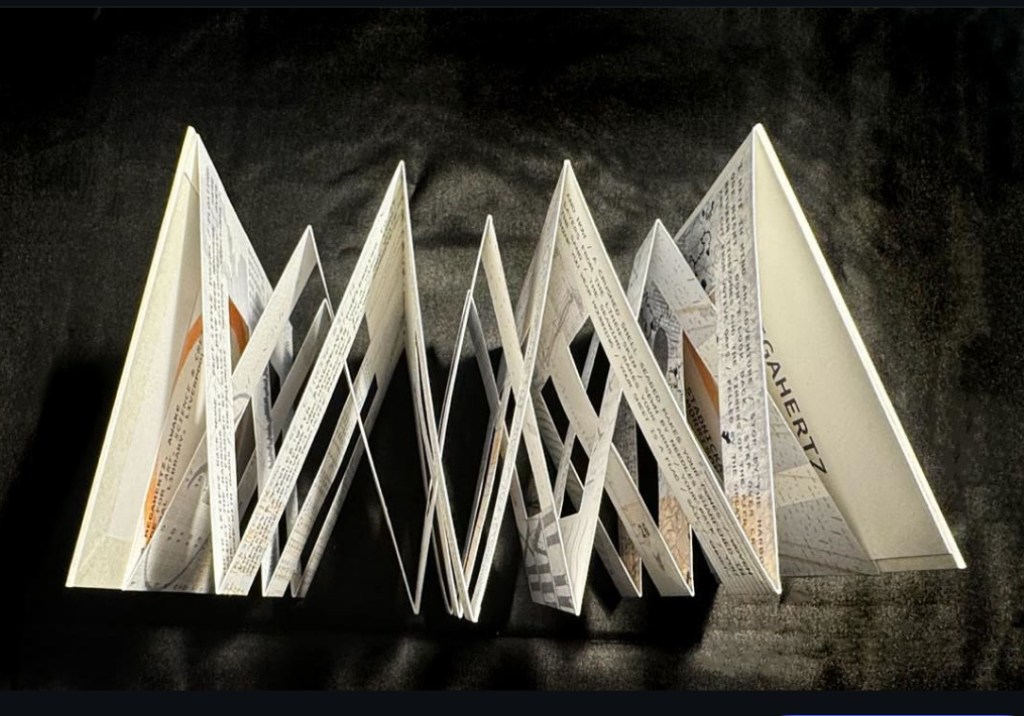
In 4 Megahertz. Awake, I trace the theories proposed by Sigmund Freud, and explored by psychoanalysis and socio-psychology, that memory has three stages: the preconscious stage (the mental space where unawareness is stored and it can inform the creative process), the pre-conscious stage (where ideas, concepts, images or feelings get to become known to the mind, but in an disorganised form) and the conscious stage (where the experience or memory becomes a coherent discourse, a literary or artistic product that is externalised and presented to the world as an art form).
The book is a collaboration with the artist Andrew Morrison, it contains language and visual elements, and it is based on the concept of “frequency”, more specifically Delta waves, frequency 2-4 Megahertz representing the wavelength associated with the brain function and language processing.
Möbius Strip is another concept that refers to the co-existence of space and time, and it is informing the structure of the book by building its content through intertwining two concertinas.
Finally, as the artists come from different cultures, disciplines and have different socio-historical lived experiences (United Kingdom and Romania), the book uses the process of “free association” used in therapeutic work and psychology, a process that allows different experiences to find appropriate correspondent in various social and historic contexts.
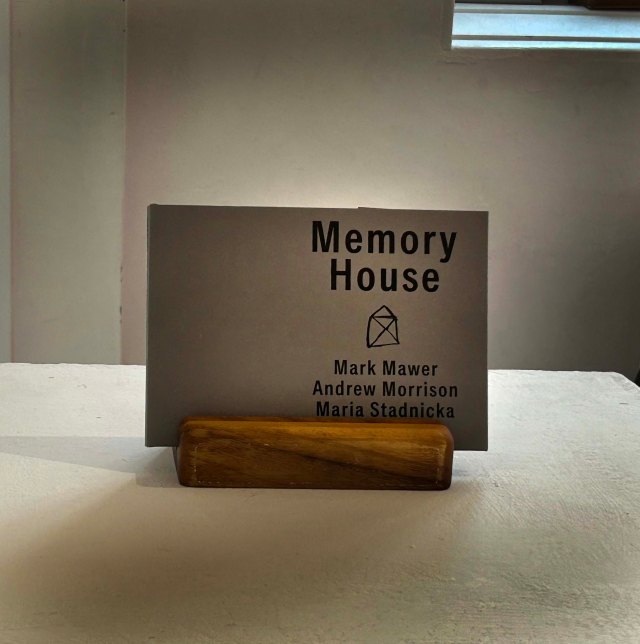
A box is a house but is it a reservoir?
Memory House, Kerbstone Press, 2024
Collaboration between Maria Stadnicka, Mark Mawer and Andrew Morrison including poetry, prose, collage, drawings.
We often think about time as being a social concept, anchored in a palpable present, routing between the past and the future. A construct that makes sense once we engage, in perpetuity, with our human experiences. In fact, what is infinite and constantly subject to our imagination and our creative processes is the past; the memories stored, processed and shared, that integrate and ground our being.
Memory House emerged as I was conducting a series of interviews for my doctoral research, with members of the Romanian diaspora, Ceaucescu’s children, currently living in the United Kingdom. The conversations about our history as migrants with experience of dictatorship, dealing with the loss of a country, family, ultimately with the loss of a language and a home, kept me company at night as I was trying to make sense of my own journey.
It was then I somehow found myself having to abruptly move house, having to decide what, if anything, from my life before his death I would carry with me in to the future and what I would have to leave behind. Undoubtedly, as I packed and sealed the luggage, all my boxes ended up being a collection of memories.
And slowly, Memory House took shape and developed into an art collaboration with the artist Mark Mawer and the poet and book artist Andrew Morrison. The past year and a half we worked to build a reservoir of images and experiences. If for me, or for the Romanian diaspora, they can be about loss, the need for connection and acceptance, with Mark and Andrew our process of reflection identified those memories that we often carry along in imaginary boxes when moving from house to house, or from one life stage to another. They map out our place of safety and become lifelong companions.
They are different for all of us yet expose the collective aspect of memory that leads to social integration and understanding, and reveal human commonalities going beyond ethnicity, background or political colour. This Memory House is a place where different generations and cultures reveal the archetypal aspects of our humanity.
(Maria Stadnicka, February 2024)
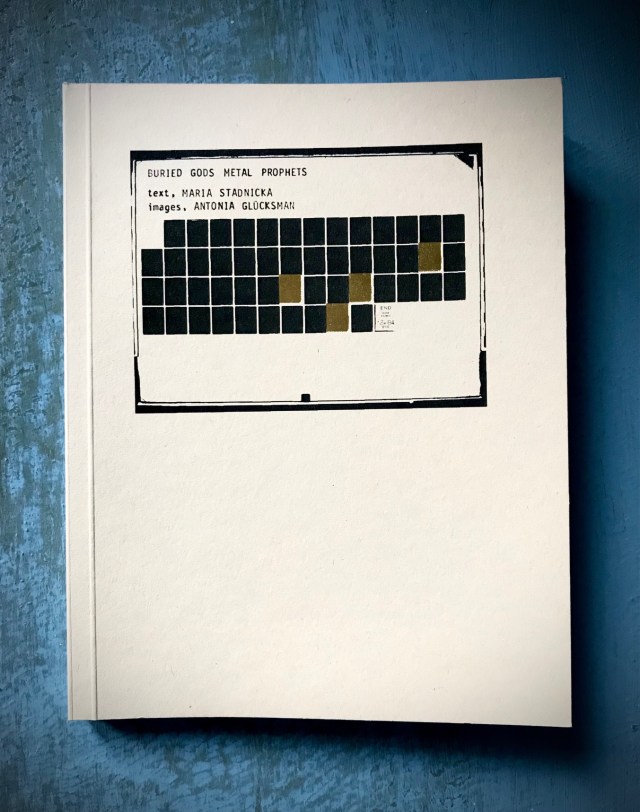
Buried Gods Metal Prophets (2021) Guillemot Press, UK.
104 pp, £12.00
Editors: Luke Thompson and Sarah Cave.
Illustrations and design: Antonia Glücksman.
The book is available here.
Highly commended for the Forward Prize for Poetry 2021 ‘Homología’ from Buried Gods Metal Prophets.
The form of intellection implied by Buried Gods Metal Prophets is a startling compound of telling detail and width of understanding, in handling severe political and social harm of kinds which might feel remote from our (“western”) experience (but are not). As a book of poetry Buried Gods includes within its function a strong documentary responsibility, to reveal, or remind us, of the acts of one of the most disastrous national European policies of the cold war period, but almost entirely focused on the orphan child’s story. […] I’m surely justified in finding this unity of lyrical and dramatic skill exceptional.
Peter Riley, The Fortnightly Review
Maria Stadnicka’s Buried Gods Metal Prophets is a classy production. The quality of paper, typesetting, cover design, and the unique illustrations throughout by Antonia Glücksman are immediately striking. The poetry has much to live up to and doesn’t disappoint. It tells the story of a Romanian orphanage against the background of the Ceausescu dictatorship: narrative stanzas intersperse with official documents (a ban on abortion, compulsory blood donation, cover-up on the extent of AIDS infection, multiple choice sin-sheet for confession), letters, diary entries and prose poems. It is a haunting, multi-layered collection in which the personal, institutional and political clash, fuse and struggle; a tension that grips the reader from start to finish and continues to seek resolution.
Rob A. Mackenzie, Magma
A must-read from start to finish, this is a story of lives under dictatorship in Romania. It has universal lessons for us all. Documents and illustrations are juxtaposed with the individual voices of protagonists. The language is astonishingly powerful throughout.
Ian Seed, writer
Welcome to the “Sputnik Wing for irrecoverables”, St. Joseph’s Orphanage, Romania, where the state is doing all it can to cover up the true nature of the “irrecoverable” children’s condition. […]Though the often have a tone of bruising directness, it would be wrong to cast these as straightforward accounts. Like Emily Dickinson, Stadnicka tells is slant. She juxtaposes poems in phonetic dialogue (“I cannot uze knives-and-forgz”) with reproductions of maps, censored documents and doctored reports (illustrated by Antonia Glücksman). These techniques recall the Peter Reading’s unsentimental, socially conscious cut-ups in Perduta Gente, but to them Stadnicka adds a tough surrealism that is all her own. When she creates dreamlike images, her tight diction gives them the bite of reality: “A stone grows in my mouth, / Between my flesh / and my heart, / rust.
Tristram Fane Saunders, The Telegraph
Stadnicka’s writing has a disquieting quality, which may be due in part to its difficult subject matter as well as the author’s own lived experience. The language is precise and austere, often relating shocking detail in a deadpan tone. ‘Radioactive milk’ relates how ‘One night / the curse shoots out of her womb / and starts walking. / For some reason / the newly born survives’. The book explores the tragic voices of both staff and abandoned children at the orphanages. One poem, written from the perspective of a child with AIDS, ends heartbreakingly, ‘I feel rather proud. / Someone has given me a name other than dog’. With keenly observed details add touches of surrealism, the book explores the effects of trauma and state oppression, as well as the realities of social, political and historical crises.
Jennifer Lee Tsai, Mslexia
Maria Stadnicka’s latest poetry collection Buried Gods and Metal Prophets is inspired by the experiences of her siblings, who lived in a Romanian children’s home between 1978-1987. This was the period of Romania’s Communist Party’s disastrous ‘Decree 770’, which banned contraception and abortion, at the same time as awarding women with more than five children an ‘Order of the Heroine Mother’. As a result, an estimated twelve million illegal abortions took place between 1967 and 1989 and over 250,000 children were placed in orphanages or care homes.
Stadnicka builds a polyphonic poetic documentary inspired by Julia Kristeva’s idea that poetry can establish ‘space and infinity’ beyond the restriction of linear poetics. The juxtaposition of narratives builds a world in which the omnipresent voice of the government echoes in the mechanised communication between the state and the individual, in a society where the private ownership of a typewriter without state permission, meant prison sentence.
Buried Gods Metal Prophets is based on her experience when working as a teacher at St. Stelian Orphanage which cared for three hundred children diagnosed with HIV and AIDS. Exposing the reality of living in state care during the Cold War, it explores the spectre of political and human tyranny that can contribute to a generational socio-cultural trauma. Children are called by numbers, not by names, and even the letters they write to Santa Claus are subject to censorship.
The creative process was informed by interviews with family members, and research around childhood trauma, neglect and child language development. The book responds to what Sartre calls literary ‘commitment and substance of enterprise’, looking at survival as an act of defiance.
UK-based Romanian poet Maria Stadnicka’s forthcoming Buried Gods Metal Prophets, published byGuillemot Press, is an astonishing collection of poems, and a testament to the tens of thousands of children who grew up in Romanian orphanages under Nicolae Ceaușescu. Bringing together historical documents of the era, lines of other authors with her “censoring” interventions, and Stadnicka’s own moving poetry, this is the poet’s fourth collection both written and published in English.
Paula Erizanu, The Calvert Journal
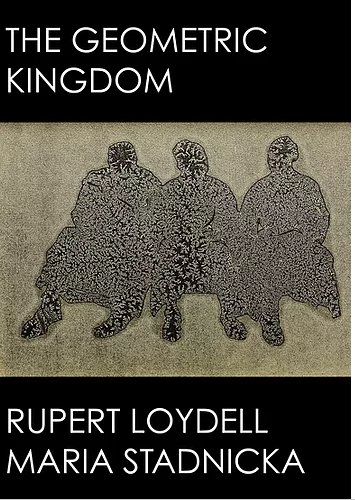
The Geometric Kingdom (2020) is published by the Knives, Forks and Spoons Press, UK. Editor: Alec Newman.
The book is available from the publisher’s website, Amazon, Waterstones and local independent bookshops.
‘Loydell is mining themes that resonate with our times, leading to collaborations with a talented array of fellow poets, allowing for a synergistic pulse of varied views. He and his fellow travelers ask difficult questions and offer open-ended answers through the time-tested holy triad of ethos, logos, and pathos.’
– Joey Madia, X-Peri
‘Stadnicka’s poetics is one of craftmanship, wherein she carefully walks the tightrope of surreal poetic metaphor and the gritty realism of investigative journalism and broadcasting. Drawing on her experiences in both, Stadnicka’s writing culminates into a distinctly inventive literary landscape.’
– Bryony Hughes, Stride

Somnia (2020) published by Knives, Forks and Spoons Press, UK. 76 pages, £10. ISBN 978-1-912211-50-0.
Editor: Alec Newman
Cover photo, collage © Mark Mawer
Somnia was included among the best books to read during lockdown by The Telegraph Arts, May 2020. The book was showcased at Blackpool Illuminations Festival 2019 and it was financed with support from the Arts Council England.
‘Dark, surreal fables, often set in war-torn or oppressive states, from a poet who has won 12 national prizes for poetry in Romania. If you like Ilya Kaminsky’s Deaf Republic and the weirder poems of Charles Simic, then buy this at once.’ (Tristram Fane Saunders, The Telegraph)
***
‘One of the best books of poetry I’ve read this year is Maria Stadnicka’s extraordinarily vivid collection, Somnia.’ (Ian Seed, author of New York Hotel, a TSL Book of the Year)
***
‘Stadnicka’s poetics is one of craftsmanship, wherein she carefully walks the tightrope of surreal poetic metaphor and the gritty realism of investigative journalism and broadcasting. Drawing on her experiences in both, Stadnicka’s writing culminates into a distinctly inventive literary landscape.’ (Briony Hughes, Stride Magazine).
***
‘Somnia is accomplished and timely, built on acute observation and drawn without judgement. The poems focus on the darker sides of humanity, the intrusion on every day lives by the political forces and show solidarity with those simply trying to protect family and survive.’ (The Journal, June 2020)
***
‘First and foremost, this is a wonderful collection: every poem is an evocative and moving vignette of personal/persona observation at its most poignant as well as uncertain. As readers we cross over surprises to arrive at others – the spaces between are landscapes of everywhere we have and haven’t been, transient like some memories, and as fixed as recurring dreams.
As an entity – the poems so often reveal their menace in pervasive rather than direct ways. They work in partnership by a different kind of sharing: obviously, the poetic which is the richly imaginative connections across and within the poems [the superb impact of all], and then there are the forces beyond individual control where our lives are determined by a common dissembling of what we thought was free-will and personal, decisive experience – and this is what we consistently read in them.
Somnia is consistently alluring and enigmatic in its poetic voice. What compels isn’t just the draw into many mysteries, but also Stadnicka’s calm creativity in conveying, for example, the horrors and/or abstractions of these – her poetic voice completely comfortable in its suggestiveness: inventive, provoking, highly visual.’ (Mike Ferguson, International Times)
***
‘There is such a quiet bravery to this brilliant and powerful collection by Maria Stadnicka. It’s a beautiful, potent book.’ (Anna Saunders, CEO Cheltenham Poetry Festival)
***
‘This collection is resonant with European and modernist echoes; the text references Camus, Szymborska and Emil Cioran, among others, and the influence of surrealism is evident throughout the collection. The poems are written in the plainest language, without much rhetorical embellishment; and yet, as in the best poetry, the meanings are hard to pin down and the poems have a depth of field which stays with the reader after the book has been put down.
The poems address war and dislocation in an unnamed land which could be many places, but reminds the reader of the Balkans conflict of the 1990s. The encounter between everyday life and shock of conflict is presented in a dead-pan tone. […] The poems give us insights into lives and experiences that couldn’t be delivered in any other way except in poetry. They also encompass the guilt and powerlessness of those viewing events from a distance. […]
Individual poems can have an almost spiritual effect, like Zen koans or proverbs, having a dream-like quality, which offer a sense of mystery, and psychological insight.’ (Alan Baker, Litter Magazine)
Somnia is available from Knives, Forks and Spoon Press, The Poetry Book Society, Waterstones and Amazon.
Somnia can also be ordered from the following independent bookshops:
Banner Books (Ennistymon)
http://bannerbooks.ie
Book Corner (Saltburn-by-the-Sea)
bookcornershop.co.uk
The Bookshop (East Grinstead)
eastgrinsteadbookshop.co.uk
Brendon Books (Taunton)
brendonbooks.co.uk
Bridge Bookshop (Isle of Man)
bridge-bookshop.com
Browsers Bookshop (Porthmadog)
browsersbookshop.com
Gullivers Bookshop (Wimborne)
booksandvinyl.co.uk/gullivers
Gnash Comics
gnashcomics.co.uk
Gwisgo Bookworm (Aberearon)
gwisgobookworm.co.uk
Haslemere Bookshop (Haslemere)
haslemerebookshop.co.uk
Hungerford Bookshop (West Berkshire)
hungerfordbookshop.co.uk
Lindum Books (Lincoln)
facebook.com/lindumbooks
Mostly Books (Abingdon)
mostly-books.co.uk
Niche Comics and Bookshop (Cambridgeshire)
nichecomics.co.uk
Red Lion Books (Colchester)
redlionbooks.co.uk
Sam Read Bookseller (Grasmere)
samreadbooks.co.uk
Wivenhoe Bookshop (Essex)
wivenhoebooks.com
The Woodstock Bookshop
woodstockbookshop.co.uk
For details and reviews, please see the ‘Reviews’ page.

If You Find My Mother, Buy Her Flowers, in collaboration with JoAnne McKay, published by The Poets’ Republic Press, 2019, Edinburgh, UK. 46 pages, £6. ISBN 978-1-5272-4710-9
Editor and preface: Hugh McMillan
Publishing editor: Neil Young
‘Maria Stadnicka is as free as the wind. Her language is unrooted by the gravity of source and evidence, though the backdrop to her poetry is a world where war and oppression are intimate. Her poetry is from a European surrealist tradition and leaps of imagination and language are the norm – “Nothing clears/ the remains of the war better/than a new haircut” – where prosaic events lead to abject images of injustice and misery, where the ghosts of war and destruction stalk the landscape, where even “people cycling home/are struck to the ground by tarry rain.”
‘All this observation could be a bleak task, but through the depth of writing, the poet re-states the durability and hope of the human voice’ (Hugh McMillan, August, 2019).

The Unmoving published by Broken Sleep Books, 2018, UK, 32 pages, £5. The book is available here and here.
***
‘The Unmoving is a dark and delicious exploration of post war landscape. Maria Stadnicka’s beautifully crafted lines cut like a knife, her poems come to the page like water from a deep well, only the well has been poisoned. Masterfully succinct and shrouded in Stadnicka’s trademark sense of mystery, The Unmoving is as vivid a poetry chapbook as you’re ever likely to read.’ (Broken Sleep Books, 2018)
***
‘A chisel, a hammer, a lyre; reportage, intimate feelings, quips and criticisms. Maria Stadnicka’s poems are clusters of consciousness, graphic, material images of our world. Her language assaults, bends, cajoles, thrusts a saber into the darkness of the very language she employs to explore death, degradation, the non-recognition of the human individual, war, urban violence, in short, the all-too-present context of our daily lives. Is there an element of grace, a lyrical thread, an invocation of human beauty? Yes, if one can continue to believe in this beauty while contemplating the profound alienation and marginalization that characterizes contemporary Western societies.’ (Andrea Morehead, Osiris Magazine)
***
‘What she accomplishes in these mainly minimalist texts is something quite special. There’s an underlying sense of ‘exile’ which permeates the whole collection and a quality of empathy with suffering, particularly related to those who are alienated within an environment, for whatever reasons. Her mixing of narrative snippets (the syntax and grammar are straightforward) with experimental jousts and fragmentary dislocation are central tenets here, which tend to make the reader focus in on every line and its relation to those around it.’ (Steve Spence, Litter Magazine)
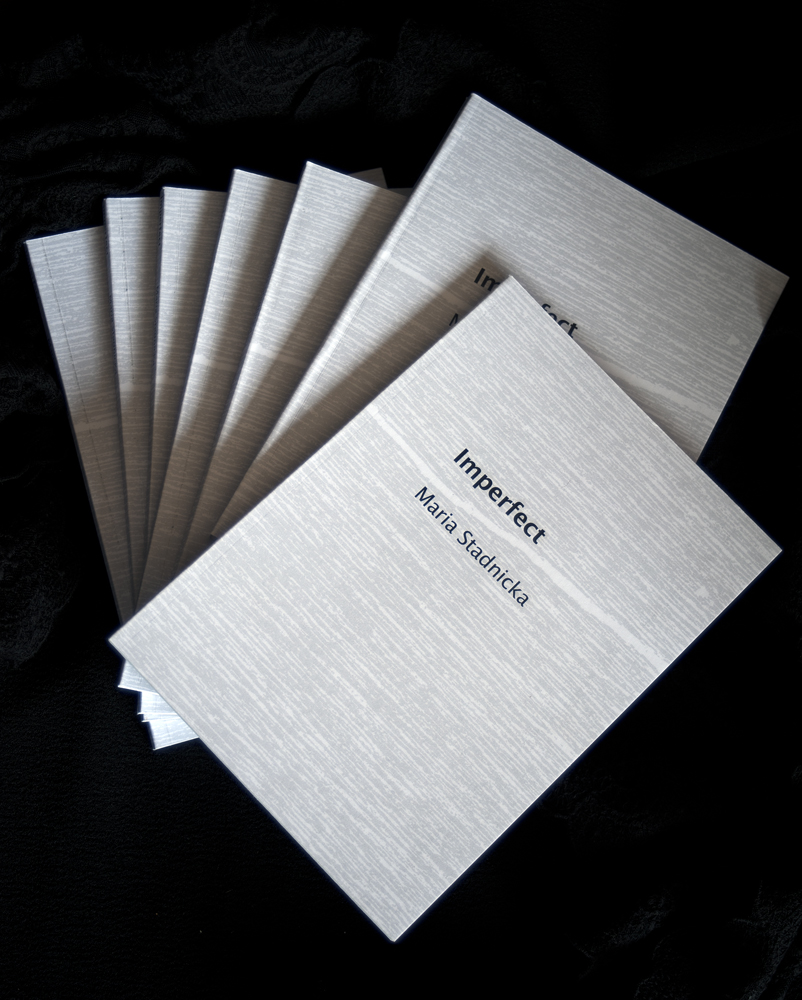
Imperfect published by Yew Tree Press, 2017, Stroud, UK. 58 pages, £10 or second edition, pamphlet form, £5. ISBN 978-0-9562038-5-4
Editor: Philip Rush
Designer: Andrew Morrison
The book is available from https://www.amazon.co.uk/Imperfect-Maria-Stadnicka/dp/095620385X/ref=sr_1_1?ie=UTF8&qid=1497303213&sr=8-1&keywords=maria+stadnicka .
***
‘Maria Stadnicka’s poetry is the most exciting I have read for some time. Her particular experience in Romania means that the political is not an option: she embraces it. Her work is on the frontline, also underscored by her background in journalism and broadcasting. But the genius of her poetry is to take the literal beyond itself into memorable and surreal flights of metaphor, while remaining firmly anchored at the same time. For English readers, her poetry is ‘other’; and I welcome that at a time when poetry needs to wake up to the contribution it can make at this time of transition and transparency. Our task as poets is to ‘see’: to divine a deeper reality. Her truth-gaze is unswerving.‘ (Jay Ramsay, author of The Dangerous Book, 2018, Fitzrovia Press and Agistri Notebook, 2016, Knives, Forks and Spoons Press)
***
‘The work reminds me of Charles Simic’s and also the gentler end of Vaska Popa’s work. There is the same clarity of images and voice with little metaphor or allusion. Instead a kind of surrealism is at work in the direction the narratives take, in the thought processes being evidenced with their jumps and asides, their sometimes surprising conclusions.’ (Rupert Loydell, Stride Magazine, 2017)
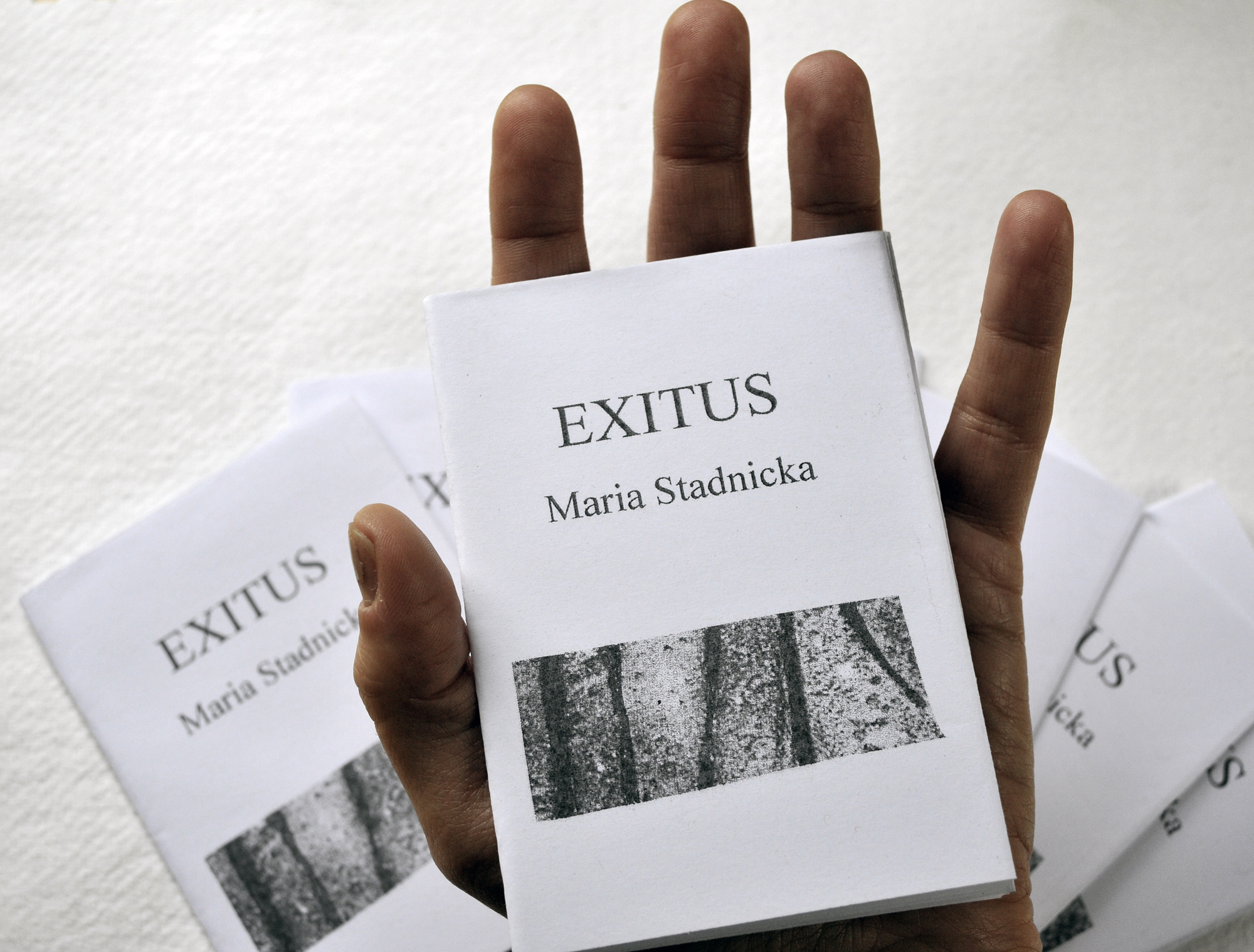
EXITUS 2017, published by Smallminded Books, edited and printed by Rupert Loydell. Limited edition.

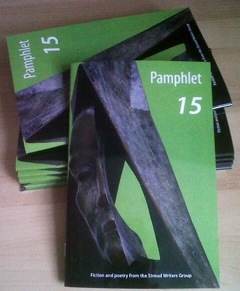
– Stroud Poets pamphlet, poetry anthology, published by Yew Tree Press, UK, 2016. ISBN – 978-0-9956603-0-4. The book is available here:
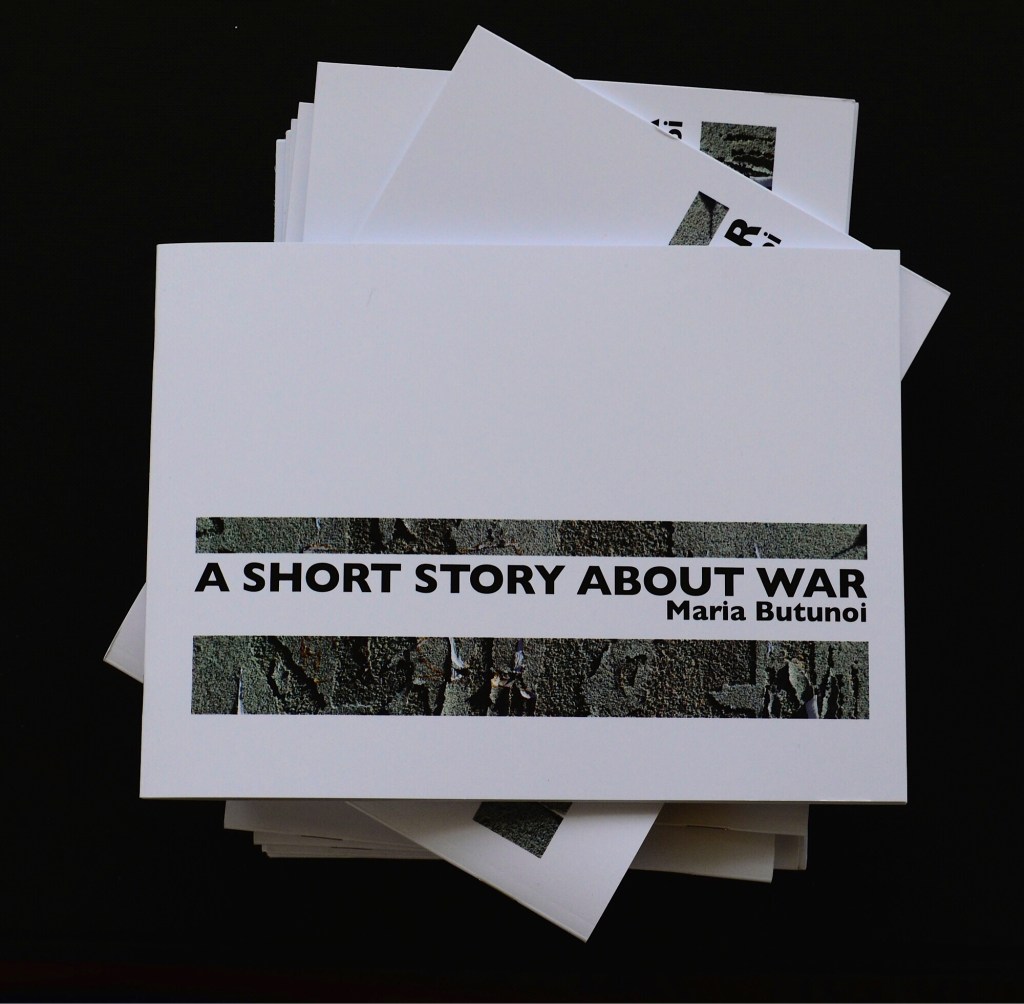
A Short Story About War, poetry collection (Yew Tree Press, England, 2014 ISBN 978-0-9562038-4-7) available here:
 Maria Stadnicka