Your Stripes Represent My Future


There are a few things I don’t care about. And one of them is which royal is going to give birth to which royal. As my friend, Mickey Mouse, used to say in his song…

I remember you was conflictin’/

in a black dress under a white coat /

and I fought /

that face I’ve seen somewhere else /

in a movie about the abuse of power. 

La, la, la, la, la, lah! 

Those around me keep on running /

I stand and convince myself /

the stripes I’ve got represent my past /

but yours /

represent my future. 

La, la, la, la, la, lah! 

No chance in the doggy-doggy fight /

I’m convinced /

that dress is bullet proof

I’m convinced it’s against repetition

and revolution and honesty.

That dress is against me, babe!

Further information, in International Times.

Carrying the World

A chisel, a hammer, a lyre; reportage, intimate feelings, quips and criticisms. Maria Stadnicka’s poems are clusters of consciousness, graphic, material images of our world. Her language assaults, bends, cajoles, thrusts a saber into the darkness of the very language she employs to explore death, degradation, the non-recognition of the human individual, war, urban violence, in short, the all-too-present context of our daily lives. Is there an element of grace, a lyrical thread, an invocation of human beauty? Yes, if one can continue to believe in this beauty while contemplating the profound alienation and marginalization that characterizes contemporary Western societies.

Although Stadnicka writes in English, her native language, Romanian, is always close to the surface of the words, forging and sculpting the associations that create the poems’ presence. Her language mirrors the human mind, elliptical at times, obsessional from time to time, fragile and reflective when the moments present themselves. ‘A moon of salt unravels / the shadow between years, / unfolding a passage / grey chapter about mortality’ offers a lyrical entrance to the book. The reader moves swiftly into the core of Stadnicka’s vision, ‘the wounds of freedom’.

One of the most beautiful poems in the book is ‘Restituto’. Transformation of thought and body occurs as the voice of the poem articulates the ars poetica, an incendiary gesture born out of an already-condemned historical contex:

I covered my face with black ink
rounded all my possessions up
set fire to everything.

The gods hid in a poem
with a fresh loaf.

Just us now slicing away
to the end of my days.

What concerns Maria Stadnicka? How do these strangely forced collages that are hermetic and yet entirely exposed allow the reader entrance to her world? She is speaking about the discontinuity of personal space and the intrusion of economic and political forces in an individual’s life that leads to fragmentation and, ultimately, to the dissolution of one’s reality. The chance for the existence of a future or even the future is removed. Literature becomes the communication and solidarity that permit the step towards wholeness. In Stadnicka’s poems social, personal, and literary landscapes are fused and at times must be forcibly dislocated, both repositioned and torn apart, so that one can continue. The reader is drawn to the quote from Czeslaw Milosz that frames the book: ‘So much guilt behind them and such beauty!’

The title poem, ‘The Unmoving’, dislocates the predictability of images and pulls together the motifs of Stadnicka’s poetry. A book slips, the world is seen as ‘a time-capsule sent flying into space’, a missile wakes the ‘half-dreaming’ narrator, someone is walking down the motorway, people materialize with a dog for sale, ‘The music absorbed what was left of Rana Plaza’ and the reader is once again confronted with the Savor Building collapse that killed 1,134 people in Bangladesh. The narrator is displaced and ‘The ground settled between reference points.’

In a sense, The Unmoving is a defense of the marginalized, the poor, the displaced and disabled. The poems create a sense of urgency and mystery. The only escape from the imposed absolute of non-being is resolution to go forward illogically and irrationally free. ‘For the first time, I / walked. Blind, absent. / I became tomorrow.’

@Andrea Moorhead, 2018

Review published in ‘Stride Magazine’.

‘The Unmoving’ is available here.

Roots

The Boris Disorder According to the NHS

Overview: The Boris Disorder is characterised by a pattern of excessive attention-seeking emotions, behaviours and statements, usually beginning in early adulthood, including excessive need for power.

Symptoms: The Boris Disorder affects politicians in different ways and can cause a wide variety of symptoms. They range from incendiary or outrageous public statements to symptomatic deceit and corruption.

When to see a doctor: It’s important to seek help from your GP if you think you may have the disorder. The sooner you see a doctor, the sooner you can be on the way to recovery.

Causes: Sometimes there is a trigger for Boris Disorder. Undeserved privileges, being surrounded by people who never disagree with you, who laugh at your badly placed jokes, and being constantly reminded of your uniqueness.

Diagnosis: There isn’t a set of tests which can lead to a clear diagnosis but the honest people around you know will now if you’ve got it. Listen to them.

Treatment: Life circumstances such as poverty, homelessness, full-time employment in the mining sector and care work, will help the sufferer to get better. Self-help groups are often recommended as well as specialist silent treatments. Prescribed ‘itching powders’ are known to improve the success rate too.

Living with Boris Disorder: Many politicians with Boris Disorder benefit from making lifestyle changes, such as giving their wealth to the poor, wearing clothes from charity shops, regular fasting, joining and supporting worthwhile causes, volunteering to the local rubbish tip. Finally, a daily session of humility might be beneficial too.

Maria Stadnicka, 8th August 2018

Gallery

Economy

Photography: ©JStadnicki, 2018

This slideshow requires JavaScript.

Soyuz. Journal Page

Ward 7H. The spring jumped on me. Donald broke a leg in the playground. The nurse ‘nitialled his file and admitted him last week. We spen’ the evenins playin’ cards. After dinner, I give ‘im chemistry equations and leave ‘im to it. But let’s continue the session.

I’m telling ya, doctor, I’m defined by objects lost in a train carriage. I am sayin’ this only to you, not to ‘hem, but I know they can read my thoughts anyway. I just know it. A burst of laughter chokes me. I zip it. My arm is num’, my smile too. Donald is watching. He breeves down my neck and I know he is smokin’ behind the curtains. The ward is full of ash. I can hear his lung. Aren’t you tired, mate? ‘Cause I am. The night guard watches. ‘come play wif me’ over a cuppa. Overall quiet.

I’m defined, as I said, by lost fings. I lost a revolver, some stamps, an umbrella. Some childhood pho’os and my dog, Derek. A plastic ruler, my dad’s jacket, my eyeglasses. A few other fings. It could be thirty or so bits of ‘istory. Stop starin’, doc’, you make me itch all over.

I’ve only known Don for a few days but I can tell he is a good egg. He ain’ talkin’ much now as he used to in 2017. Kindda lost his shine a bit, his hairs, but he’s watchin’ over me like a God. I’ve started prayin’ to him now and he’s chuffed. He likes me. This morning he came by my bed and gave me a present. A nuclear boomerang. Hallelujah!

Published in ‘International Times’, available here.

©Maria Stadnicka, 2018

Quote

Picket Line

via Picket Line

Picket Line

Photography: @JStadnicki 2018

I wanna protest

against Trump but mama says

I’ve got eczema,

there’s ironing left

to do,

the lawn, the beds,

bleach,

scrub the stairlift,

move the mouse-trap from A to B

once I’ve finished with that I should

make a start at

boiling jam.

Seventy-quid-train-fare should feed us all

the week after the picket.

I wanna protest

against mama but Trump

turned the noise right up

in my slum we think

earmuffs should do

she has a whole load of washing

my homework needs checking

for subversive context

a neighbour lost a cat and

she’s now on the phone with 111.

I am not heard.


@Maria Stadnicka, 2018

Graffiti

Illustration: ©Claire Palmer, 2018, for International Times

– unedited preview from ‘The Unmoving’ coming out next month at Broken Sleep Books, published this morning in ‘International Times’:


I imagined the return at the end of my sentence

on a street in Moscow

thinking the worst was already over.


[ more to follow…]


BarKing Powder

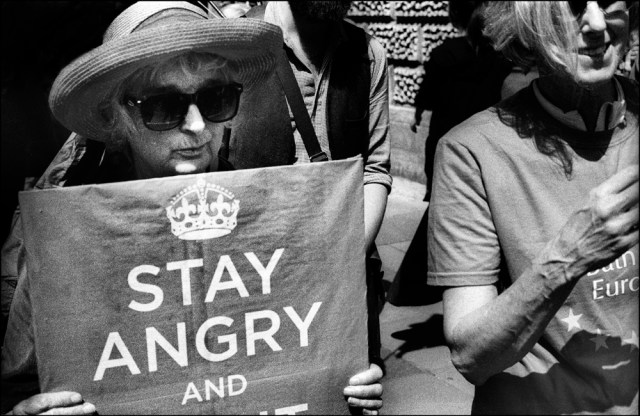
When I was a child and lived in an overheated three-bedroom second floor flat, my brothers used to make water bombs. They would fill plastic bags up with cold tap water, tightly knot them, and throw them over the bedroom window every time they would see a pretty girl crossing the alleyway underneath. The water splashed all over the victim and they laughed their heads off, behind curtains. This detail came to mind watching the Brexit process taking place, month by month.

Photography: @JStadnicki, 2018

On reflection, the ‘hahaha-hihihi’ is coming this time from Downing Street as I get on with my form-filling life.

It’s has been hot recently (anyone noticed?!), even I can admit to that, and I’m used to Siberian summers. However, the heated discussions among the ministerial flock have raised the warning level from orange to red as nobody seems to have a clear view-point, nor an exit plan or a rescue package. It feels more and more like we’ve all been hoarded up into a long-haul flight, with a crew of unqualified attendants. In case of crash, it’s going to be ‘each to their own’.

Earlier in the week, the BBC mentioned how the PM is risking a revolt (I wish!) if the ‘type of Brexit she promised is not delivered’. Come on, Duncan, calling the PM ‘insolent’ on Twitter will not bring a velvet revolution. When Tusk issued a ‘last call’ at last week’s summit in Brussels, he didn’t mean your plane to the Maldives was about to take off. He meant business as you were about to sip another cooling lemonade. Last Saturday, a ‘livid’ Gove physically ripped up a report (did he really?!) for a new customs partnership with the EU. Qui prodest?

I get to understand miss Vicky when she said we needed a ‘practical, pragmatic deal that gives certainty to business and trade… not an ideological one’. The only things with it is …. everything on paper stays on paper and, therefore, is ideological. I’m back, for now, to reading Nausea. It makes, by far, a clearer point.

We are about to leave, I’ve got used to the idea by now, but there isn’t a destination on sight. We might find ourselves flying over the European economic space until the engine runs out of fuel. And then, let’s see who’s got a parachute.

©Maria Stadnicka, July 2018

published in ‘International Times’ / 3rd July 2018