Ourselves or Nothing

The Country Between Us firstly appeared in 1981, published in the US by Harper & Row, at a time when the conflict in El Salvador had finally forced its way into public awareness. At the time of publication, The Iowa Review placed the collection among the most notable books of a young poet in recent years. The book received the Poetry Society of America’s Alice Fay di Castagnola Award and it was the Lamont Poetry Selection of the Academy of American Poets. The collection has been reissued this spring in the UK, by Bloodaxe Books.

Structured in three parts, ‘In Salvador, 1978-80’, ‘Reunion’ and ‘Ourselves or Nothing’, The Country Between Us explores the socio-cultural devastation of a country ripped apart by civil war. Although Carolyn Forché worked as a journalist and investigator for Amnesty International, and was closely involved with the political struggle in El Salvador, her poems are personal, immediate, and moving. The collection resists the temptation to sensationalise, and responds to Wittgenstein’s definition of poetic relevance through a masterful use of a language of information which does not, however, give information:

If we go on, we might stop

in the street in the very place

where someone disappeared

and the words Come with us! we might

hear them. If that happened, we would

lead our lives with our hands

tied together.

[from ‘San Onofre, California’]

The horrors of war Forché relates are referenced with subtlety and control of the language. In the poem ‘The Visitor’ she only suggests the cruelty of a civil war, in which ‘There is nothing one man would not do to another’ (p.17), whilst in ‘Message’ she alludes to the war’s impact on people struggling to establish a sense of normality:

Margarita, you slip from your house

with plastiques wrapped in newsprint,

the dossier of your dearest friend

whose hair grew to the floor of her cell.

Leonel, you load your bare few guns

with an idea for a water pump and

co-operative farm.

[from ‘Message’]

Forché builds her lyrical power through subjective connections established between herself and the events unravelling in front of her eyes. History becomes therefore meaningful and relevant to readers, who construct references and personal connections. Her directness brings in focus César Vallejo’s poetics, as well as Pablo Neruda’s and Miklós Radnóti’s, through her ability to correlate cultures and transcend times:

When we listen

we hear something taking place

in the past. When I talk to her

I know what I will be saying

twenty years from now.

[from ‘The Island’]

Perhaps one of the greatest achievements of Forché’s The Country Between Usemerges from her ability to confront politics and history, beyond their national and cultural boundaries. It reaches out to a readership who might not ordinarily read poetry. The strength of the collection is underlined by the honesty in exposing human suffering. It is done with sensitivity, maturity and without condescendence. A collection which opens a wider range of questions about the meaning of history:

It is either the beginning or the end

of the world, and the choice is ourselves

or nothing.


©Maria Stadnicka, 2019

Published in Stride Magazine, 29 May 2019.


Gallery

Readers at Hay-on-Wye Literature Festival

©John Stadnicki, 2019

The History’s Dog

‘Man bites dog’ is the first principle learnt at uni. Thought I could never fully picture the concept, I always imagined the breed of dog which would make man resort to such extreme behaviour. Despite its metaphoric connotation, ‘man vs dog’ has proven to be a successful broadcasting formula for decades. With time, the ‘dog’ matters less and other realities take its place.

News moves with fluidity on the axis entertainment – truth value. It becomes irrelevant that the closer to entertainment, the further we slide away from reality. Whilst audiences are locked in a labyrinth of breaking news and data, most people have little time to investigate what goes on in the real world. It is not surprising that among the most googled questions one finds what time is it?, is it going to rain today?, how can I make money? or what is my name?. Who has the luxury to look beyond? We trust that journalists have it, and they should take the responsibility upon themselves to bring forward the missing parts of our world. And they do.

© Committee to Protect Journalists, 2019.

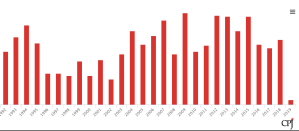
Without their work, I wouldn’t have known that, between 1997-2006, 378 journalists were killed doing their job. I wouldn’t have known that Wikileaks was already one year old in 2007, three months had passed since Anna Politovskaya’s murder, a new diplomatic row started between London and Moscow (over Britain’s bid for extradition of Andrei Lugovoi, an ex-KGB agent accused of Litvinenko’s murder), that Russia suspended participation in the 1990 Conventional Armed Forces Treaty in Europe (a treaty that limits the deployment of heavy military equipment across Europe.)

I wouldn’t have remembered that the EU expanded with two more states, Romania and Bulgaria, Barack Obama was in full presidential campaign and Gordon Brown moved from 11 to 10 Downing Street. 2007, a few months till the Lehman Brothers Bankruptcy, which triggered global recession. The Doomsday Clock was moved to five minutes to midnight in response to North Korean renewed nuclear ambitions and tests. The War in Afghanistan and the Iraq War, in full swing.

These are facts from a distant past now. History. It is already history that 612 journalists were killed doing their job, between 2007-2016. Almost double than the previous decade. History too, last week’s sigh of relief watching Notre-Dame being saved by a near-miracle. In the meantime, history added a new name to statistics: Lyra McKee.

©Maria Stadnicka, 2019

Published in International Times on 27/04/2019.

Sonata


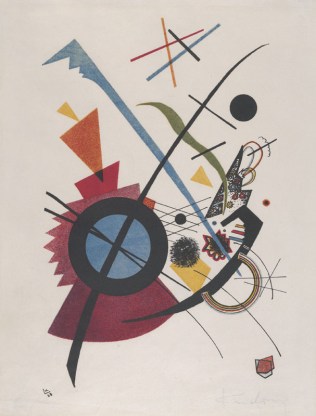
Violet, by Vasily Kandinsky, 1923, Russian French Expressionist print, lithograph. Geometrical elements, circles, arcs, triangles, straight lines and curves, mix with irregular hand drawn forms in this abstract lithograph (BSLOC_2017_5_148)
1923 / Mary Evans Picture Library


It starts with a study in curves.


Lost in broad daylight, I think

in intimate terms about pencils,

sharpened by a schoolboy

oblivious to Barthes’ empire.


Time, the only thing I have not.


I shall pray for you she hissed, leaving.

Ashes to ashes I laugh,

turn the machine off, move

closer to anger.


Hands, metal, ankles, metal, eye. Metal! Nerves.


I practise benign indifference.


I learn about human squares and circles,

underline the connective distance

between something lost

and something irreplaceable.


© Maria Stadnicka, published at Mary Evans Picture Library.

The Euro Vision and the Gold Rush #Flashnews (part IV)

@JohnStadnicki, 2019. London.

Over a month ago, the media pointed out that the price of gold increased again. A sign that investors are using gold against weaker stocks, as a response to the uncertainty surrounding Brexit and the trade disputes around the world. But even a child knows that when gold starts shining, it is a sign of trouble ahead.

The recent Brexit developments send waves of worry throughout Europe, whilst governments across the English Channel are increasingly interested in taking back control over their money.

Only a year ago, the National Bank of Hungary took back three tons of the country’s national gold reserves stored at the Bank of England. The decision followed similar reactions from Austria, Germany, Holland and Venezuela, which considered storing the national gold reserves in London a risky decision.

For a few days now, the Romanian authorities have been debating whether to take back their sixty tonnes of gold stored in the London vaults. With the crisis of storage space the British authorities have been facing for years, I imagine that storing a country’s national gold is not cheap.

Sixty tonnes is, by any means, a lot. Imagine ten elephants put together, if one takes the average weight of one elephant at around six tonnes. To put it simply though, the average weight of 15 people together, say, in an elevator, is about one tonne. By the same logic, sixty tonnes of Romanian gold is about 900 Romanian migrants, currently living in London.

What would be the weight in gold of 300,000 Romanian migrants currently in the UK? And what about the 3.7 million European migrants, in the UK? Imagine that gold! Imagine the value!

But in this equation, and in all Brexit negotiations, who is looking at what value people have, when financial interests are at stake?

©Maria Stadnicka, 2019.

Published in International Times, 9/03/19.

Witness

At the supermarket’s meat counter,

they sell ropes. Yellow and blue.

Things we need when weather turns bad.

One could never be sure when the boat

needs tying off to a cleat.

At checkout, we talk of hurricane Ursula.

It was in the news, it is now by the docks.

My bottled green sea resting on shelves.


Across the aisle, a woman looks out.

Trains deliver milk and morning newspapers;

at the end of his shift, a night watchman

lights a cigarette watching umbrellas running

to shelter. He has nowhere else. His children

sent him a blank telegram. Monochrome winds,

he thinks. Time to repair, to build.

The house he was born in no longer exists.


©Maria Stadnicka, 2019

Published in Social Alternatives, Queensland, Vol. 37, No. 3.

On Euro Vision and the Migration Strategy #Flashnews (part III)

©John Stadnicki, 2019.

In 2012, Theresa Mary May (née Brasier) was just a mere Home Secretary. She was under pressure from David William Donald (née Cameron), who was fighting Nigel Paul (née Farage) on the electoral front, to do something about the migration data. And she had an idea which got her a few brownie points from the PM. ‘Dave, why not produce a hostile environment for undocumented migrants,’ she said, to which the PM responded ‘Well done, Theresita, that’s my girl.’ And, as simple as that, the hostile environment strategy was conceived on a sofa in 10 Downing Street, and later on ended up being implemented.

The strategy is up and running since 2016. The Guardian(ed. 16th Feb. 2019) reports that the Home Office is attempting to embed immigration officers at a rate of almost £60 an hour as part of an ‘enhanced checking service.’ The service is available to public services, including NHS trusts and local authorities, as well as private firms. Over the past two and a half years, Home Office officers have been deployed to test the policy. But the strategy is not just about ‘enhanced checking.’

Institutions and organisations are offered ‘real-time’ access to information about someone’s immigration status as well as ‘on-site immigration official.’ The on-site officer can attend interviews and can encourage undocumented migrants to leave the country voluntarily. There is no public information about the methods used to encourage people to leave but, hopefully, with the media’s pressure, the Home Office will release further details.

I will not explore any further how the public funds are used under the pretext of national security. The governmental misjudgement and funding misplacement are, by now, legendary locally and Europeanly. And the Home Office’s policies seem to fit well a system based on miscommunication and misunderstanding.

There is something more bothersome I came across not very long ago. A few weeks ago, I came to understand that a young British citizen, travelling by train from London to Paris, managed to cross the border without a passport. The UK Border Agency let the young Brit off on the basis that the teenager was travelling as part of the group and had a scanned copy of his passport saved on a laptop. Although getting out of the country was easy, coming back from Paris a few days later created a bit of a problem at the Parisian train station. But the British citizen managed to get back to Britain on his scanned document, whilst the UK Border Agency’s officer warned the eyewitnesses that he would put a complaint against the section of the UK Border Agency which had let the person travel in the first place. Well, who is going to check that such a complaint was actually put forward?

The questions this incident brings forward are numerous. The issue of ‘legality’ in such a case would be the first, followed by the problem with the Home Office’s wasted funds on ‘monitorisation.’ And there are rhetorical points here. What is the point in having passports, if one could just travel without? Would a migrant have been allowed to travel from the UK to Europe and vice-versa without a passport? If I turn up at Heathrow or St. Pancras with just a scanned copy of my passport, will I manage to cross the border without problems? (to be continued)

©Maria Stadnicka, 2019

Published in International Times on 2/3/2019.

On Fashion and Euro Vision #Newsblitz (part II)

©John Stadnicki, 2019, Paris

I spy with my little eye something beginning with…..P. [I can see you looking around.] YES! Correct! You spotted them too. P-rotests.

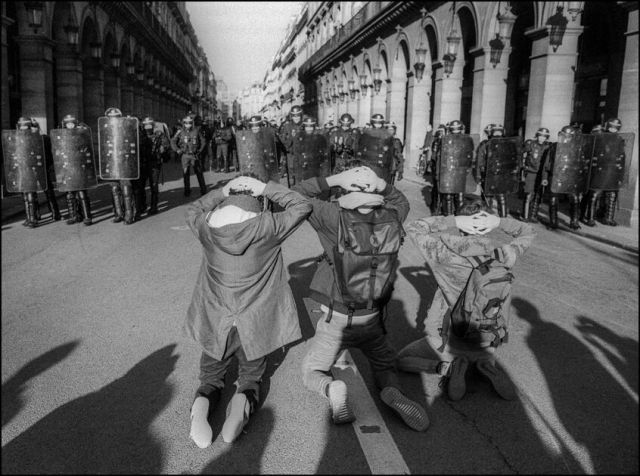
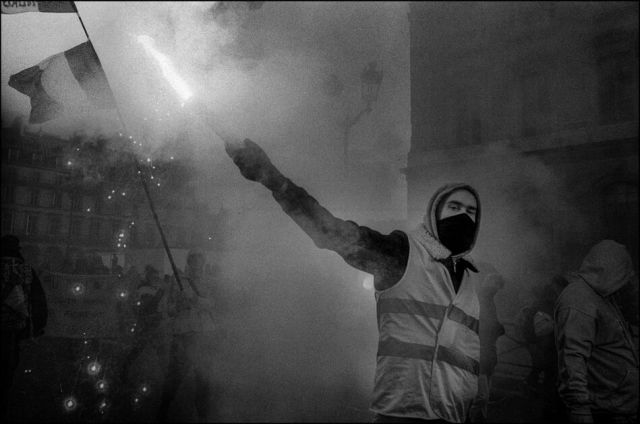
Three months of P-rotests in France. The revolt started in November last year with the ‘gilets jaunes.’ The P-rotesters have called for lower fuel taxes, reintroduction of the solidarity tax on wealth, a minimum wage increase, the implementation of Citizens’ initiative referendum and Emmanuel Macron‘s resignation as P-resident of France. From yellow vests, the social unrest extended to include the ‘red P-ens’ when six teachers launched an online campaign against low P-ay and untackled aggression against teachers in schools and colleges. In a few weeks, the movement gathered over sixty thousand members, demanding P-ay renegotiations and P-olicy changes.

©John Stadnicki, 2019, Paris

Further on, from ‘red P-ens’ to ‘red scarves.’ At the end of last month, a counter-demonstration occurred in Paris by a group identifying themselves by the ‘foulards rouges’ (red scarves) they chose to wear. The ‘red scarves’ are against the ‘yellow vests’ and reject the threats and verbal abuse aimed, they say, at non-yellow vests.

At the moment, it might be tricky to wear something in France without making a P-olitical statement. And maybe for this alone, not long ago, Britain chose to offer France a different approach to expressing discontent.

You might recollect, on 8thFebruary, John Humphrys (who’d just announced his P-robable retirement from Radio Four) blushing over his microphone, when questioning the naked anti-Brexit campaigner. And during their discussion someone mentioned another word starting with P. This time was…P-rude. Whether John Humphrys is a P-rude or not is a matter of P-ersonal life, therefore irrelevant here. The media reported the rattling sounds in the studio, others were offended for having to imagine stark nakedness so early in the morning.

A week later though, nothing really changed. We are back to our daily routine, whilst Westminster is holding its nerve. Would you have imagined that a naked campaigner could P-rovoke a change in Britain, when thousands of P-rotesters and bloodshed fail to move an entire French government? I have to admit, I P-erversely thought that it could. P-ossibly. Despite my misplaced P-erversity, or hope, I sense the slow built-up towards a national nervous breakdown. (to be continued)

Published in International Times on 23/02/2019.

©Maria Stadnicka, 2019

On Polar Bears and Euro Vision #Newsflash (part I)

©John Stadnicki, 2019

There is an invasion of polar bears in Russia. And the British press finally found out about it. When it happened, a week ago, the media wasn’t that interested to begin with. To be more specific, last week, the Russian authorities in the Novaya Zemlya islands declared state of emergency after dozens of polar bears entered residential and public buildings searching for food. This has been without precedent in the region and raises the climate change reality to a new level. And not just the climate change, in general, but the reality of heavy urbanism, socio-economics, pollution and many other sins of the neo-liberalist economies.

The British press wasn’t that keen on bears for reasons which can be, in part, understood. It applies the law of proximity. News is news only if it’s close enough to us. Last week, the media had a different concern. With the news about the British singer selected to perform at Eurovision, it had to re-think the strategy around coverage from Tel Aviv. And, lastly, the same media became consumed by an acute need to compete in predicting how bad things will be for all of us, once we are out of the EU. It is worth a mention that there are voices still in disbelief about Brexit. But there are increasingly more voices who question the whole legitimacy of the vote and the basis on which the Brexit process is based on.

In 2016, the Brexit referendum was primarily an electoral manoeuvre proposed by David Cameron who had become increasingly concerned with the threat posed by UKIP. The opportunism which motivated the referendum did not have the people’s best interest at heart. The government failed to articulate what Brexit really involved because Brexit was not actually supposed to happen. It was merely an exercise to get David Cameron elected and the Conservative Party united. When the politicians woke up to the shock results, the slogan ‘Brexit means Brexit’ took ground and quickly became a governmental mantra. The ministers themselves were unclear what Brexit meant and what plans needed to be in place to make the transition possible.

Two years later, after ‘heavy’ negotiations and ‘nerve holding,’ the political class is still praying for a miracle from Brussels, stocking paper and ink for the legislative system in need of restructure. In the meantime, millions of people who voted ‘pro’ or ‘against’ in 2016 are getting used to the shortage of beds in hospitals, the crowded doctors’ surgeries, the pharmacies experiencing delays in orders, the train cancelations, the ‘out of order’ buses, the increased criminality and suicide rate, the unaffordable houses. Many know, as they’ve been told in 2016, that the main problem this country has is the migration and not the polar bears nor the politics. And although people also know this is all a lie, they are too busy queuing, and put up with it. The French put up with far less.

(to be continued)

©Maria Stadnicka, 2019

Published in International Times, 16 Feb. 2019

Gallery

Gilets Jaunes Live

This slideshow requires JavaScript.