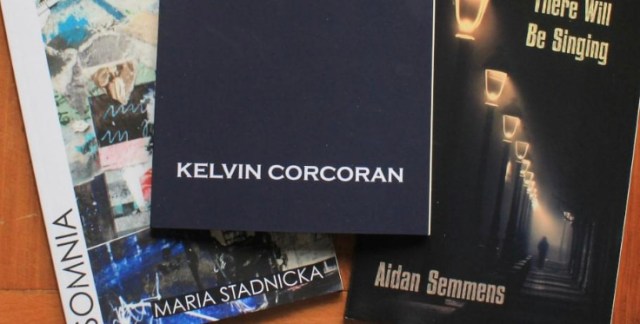
You are cordially invited to join us on Tuesday 25th August at 7.30pm for a poetry reading like no other: Kelvin Corcoran with The Republic of Song (Parlor Press, 2020), Aidan Semmens with There Will Be Singing (Shearsman, 2020), Maria Stadnicka with Somnia (Knives, Forks and Spoons, 2020).
There Will Be Singing: Aidan Semmens’s fifth collection of poems moves from the range of the world to the deeply personal, always placing the detail in historical context. Employing a variety of poetic techniques, he moves from the moral ambiguities of empire to the run-in to Brexit; from a reworking, forty years on, of the poem for which he was awarded the Cambridge University Chancellor’s Medal, to the breakdown of language suffered by his mother after an ultimately fatal stroke.
“There’s an exuberance of the poet in full stride. Typically, the phrasing and imagery are seductive and of the physical world being lived. Learning is carried lightly, erudition not pushed at the reader but drawn into the lyricism.” —Kelvin Corcoran
Somnia: included among the best books to read during pandemic by The TelegraphArts critics, Somnia is a series of dark, surreal fables, often set in war-torn state – (Tristam Fane Saunders, The Telegraph). ‘Stadnicka’s poetics is one of craftmanship, wherein she carefully walks the tightrope of surreal poetic metaphor and the gritty realism of investigative journalism and broadcasting’ (Bryony Hughes, Stride); Somnia is accomplished and timely, built on acute observation and drawn without judgement. The poems focus on the darker sides of humanity, the intrusion on every day lives by the political forces and show solidarity with those simply trying to protect family and survive’ (Emma Lee, The Journal).
The reading will take place on the Zoom platform and it is free. Email mariastadnicka@yahoo.co.uk for the link and password.
The Tears in the Fence Festival this year is on 10-13th September via Zoom video conferencing.
The Festival has a long history back to the 1990s and has always attempted to showcase a range of alternative voices associated with the magazine and workshop group. Each themed event stems from the issues of the day and attempts to continue conversations from the previous Festival. The Festival consists of readings, discussions, conversations, and is a gathering of friends and an opportunity to make new friends. Previous themes have included ‘Difference and the Other’, ‘Visionaries and Outsiders’, ‘Hidden Connections’ and ‘The Politics of Engagement’. This year’s theme in the shadow of Covid-19 and Black Lives Matter is ‘Lost Connections: Light and Darkness’.
There will be sessions around migration, environmental, multilingual, power and gender dynamics, colonial issues as well as the solitudes and vicissitudes of lockdown. There will be talks, videos, conversations with celebrated poets and the opportunity to question readers and panellists. Above all, there will be stimulating readings and conversations. We shall also be using breakout rooms for further late night social discussions.
Amongst our guests will be Sascha Akhtar, Sarah Cave, Simon Collings, Rachael Clyne, Jennifer K. Dick, Andrew Duncan, Allen Fisher, John Freeman, Mandy Haggith, L. Kiew, Hari Marini, Rethabile Masilo, Geraldine Monk, Jessica Mookherjee, Joanna Nissel, Rhea Seren Phillips, Jasmina Bolfek-Radovani, Gavin Selerie, Aidan Semmens, Maria Stadnicka, Cherry Smyth, Harriet Tarlo, Olivia Tuck, Molly Vogel plus some surprise guests.
Tears in the Fence encourages social inclusion and welcomes under-represented poets and writers to attend this year’s festival. 15 free bursaries are on offer to anyone who might not otherwise be able to attend.
Bursary applicants may identify as (but are not limited to) any of the following: BAME writers, writers on no/low income, working class writers, writers from areas of rural or coastal deprivation, writers who have experienced homelessness, refugee writers, writers in the LGBTQ+ communities, writers who have survived abuse, disabled writers, neurodivergent writers, and writers with chronic health conditions. To apply for a free pass to all festival events please email tearsinthefence@gmail.com with the subject line ‘2020 Festival Bursary’. These will be issued on a first come, first serve basis.
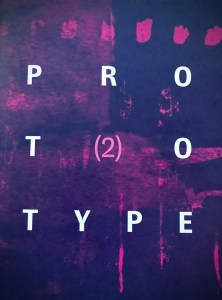
Prototype 2020, prose and poetry anthology published by Prototype Publishing, London, p.175, ISBN 978-1-913513-03-0.
Editor: Jess Chandler, Designer: Theo Inglis
The anthology includes work written with Rupert Loydell for the forthcoming collection The Geometric Kingdom.
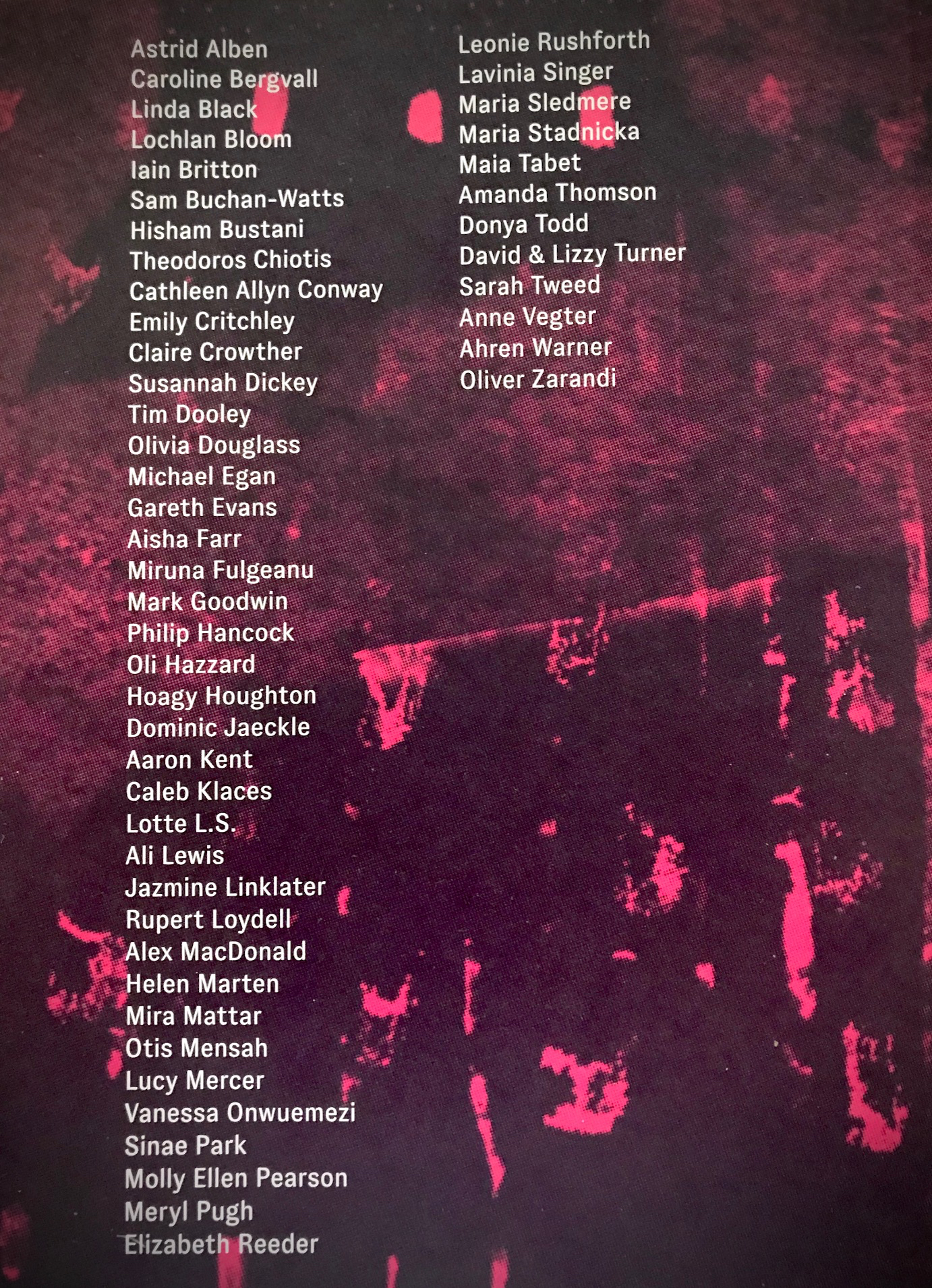
Writers: Astrid Alben, Caroline Bergvall, Linda Black, Lochlan Bloom, Iain Britton, Sam Buchan-Watts, Hisham Bustani, Theodoros Chiotis, Cathleen Allyn Conway, Emily Critchley, Claire Crowther, Susannah Dickey, Tim Dooley, Olivia Douglas, Michael Egan, Gareth Evans, Aisha Farr, Miruna Fulgeanu, Mark Goodwin, Philip Hancock, Oli Hazzard, Hoagy Houghton, Dominic Jaeckle, Aaron Kent, Caleb Klaces, Lotte L.S., Ali Lewis, Jazmine Linklater, Rupert Loydell, Alex MacDonald, Helen Marten, Mira Mattar, Otis Mensah, Lucy Mercer, Vanessa Onwuemezi, Sinae Park, Molly Ellen Pearson, Meryl Pugh, Elizabeth Reeder, Leonie Rushforth, Lavinia Singer, Maria Sledmere, Maria Stadnicka, Maia Tabet, Amanda Thomson, Donya Todd, David Turner, Lizzy Turner, Sarah Tweed, Anne Vegter, Ahren Warner, Oliver Zarandi.
24th April 2020. Britain just passed the peak. A live broadcast from Downing Street shows an increase of over 5,500 cases of COVID-19 in 24 hours. It is lower than earlier in the week and there are more good news. The PM has made a full recovery from his encounter with the virus and he is now expected back in the swing of things.
Analysing newspapers’ front pages from 24th April 2020, I find headlines suggesting how a ‘grateful Britain’ (Daily Mirror) is slowly ‘taking back control’ (The Daily Telegraph), with the help of ‘mass testing to get Britain back on her feet’ (Daily Express). At the same time, hospitals are struggling with significant PPE shortages, with ‘failings in the privately run virus test centres’ (The Guardian) and are ‘running out of dialysis kits’ (The Independent).
A snapshot of the ‘new normal’ (The Scotsman) in April, when things are bad and better at the same time. The sigh of relief from governmental departments is so loud, I can almost hear it from the Midlands in the lockdown quietness.
Weather is good, but the angst caused by the ’emergency stop on economy’ is wearing many out. As my professional and social life move online, days and nights blend into each other, in a confusing melange of obsessive handwashing, sleeplessness, overeating and virus paranoia. I would believe anything as long as it brings hope.
The worst has passed and social media takes comfort in the heavily quoted words of Pastor Olawale Daniel who prophetically anticipates the arrival of ‘a time to go back to the drawing board and rewrite the next phase of our existence’.
I admit I have not heard of Pastor Olawale before the pandemic and, checking his website, I am still unable to trust the source but for a while his quote goes viral on social media. Maybe it speaks to a yearning for social change, in a moment when, having lockdown time for reflection, we realise that we have been going in the wrong direction.
25th May 2020. I’ve already been introduced to the science behind the R number. The press conference in Downing Street is chaired by the PM himself who announces an increase in number of COVID-19 cases with only 1,600 in 24 hours. Britain’s records show that 36,900 people died infected with COVID-19, but I’m re-assured that things are ‘being controlled’.
Unfortunately, trust in the government’s concerted narrative ‘together against the virus’ suffers a big blow following the Cummings-gate media revelations.
Newspapers’ front pages explain how the PM’s aide, ‘a cheat’ (Daily Mirror), offers ‘no apology, no explanation’ (The Guardian) for breaking the lockdown rules. While some newspapers report that ‘he acted responsibly, legally, and with integrity’ (The Daily Telegraph), others call for the ‘aide’s sacking’ (The Scotsman) and the public opinion begins to split, reigniting the arguments which fuel the narrative ‘them and us’. My professional and social life are still booming online, weather is good, and then something else happens.
George Floyd is killed in Minneapolis at 9.07pm. Britain is asleep (3.07am) and about to wake up to an updated version of the ‘new normal’; a social normality forced back to the ‘drawing board’ by the inequality and the injustice which stained our system before the COVID-19 pandemic, and our systems before that, and even earlier than that, as back as history can remember.
7th June 2020. The statue of Edward Colston is toppled and removed by protesters supporting the ‘George Floyd Movement’ in Bristol. The British Home Secretary points the finger at the destructive ‘mobsters’ and the House of Commons heats up with MPs recognising the urgent need to improve our education system. We have not learned enough from the past, nor thought enough about a future free from racism, discrimination and injustice. At this point, volume goes up in my headphones.
It is a mistake. A mistake, for I can hear Sam Terry (MP for Ilford South) saying how UK universities must be:
valued as part of the frontline response to the coronavirus pandemic, […] and recognised for the role they can play in their local economies in terms of retraining and reskilling their local workers during any recovery from the pandemic. (2020, p.1)
The hope for fresh beginning in the ‘new normal’ gets crushed. Shouldn’t universities be recognised for all their roles, for their contribution to developing critical thinking and creativity, science as well as arts and humanities? If not, then what is the point in having higher education in the first place?
With philosophy, literature and art courses being scrapped in many British universities, public libraries closing, an art sector barely surviving under the new rules of social distancing, our children’s chance to reflect on and to learn from past mistakes is significantly undermined. Not that economic recovery is irrelevant, far from it; but looking at the underlying societal disease caused by ‘outcomes’, it seems that we are moving backwards. Almost as back as 1935 when Bertrand Russell observed a similar symptomatic failure in the education system:
Educational commissions point out that fifteen hundred words are all that most people employ in business correspondence, and therefore suggest that all others should be avoided in the school curriculum. (1935, p.34)
Russell criticised the education system tasked to avoid ‘useless’ knowledge, without practical applicability and immediacy, pointing out the insurmountable value of philosophy and literature, for instance, in creating better visions for the future.
Surely in almost a century we moved beyond fifteen hundred words, surely our world-leading higher education system looks nothing like the system described by Russell in 1935:
Knowledge everywhere is coming to be regarded not as a good in itself, or a means of creating a broader and human outlook on life in general, but as merely an ingredient in technical skill. Educational establishments are not allowed to spend their money as they like, but must satisfy the State that they are serving a useful purpose by imparting skill and instilling loyalty. (In Praise of Idleness, 1935, p.38)
Writing In Praise of Idleness, Russell had the experience of the Great Depression. The Stock Market Crash followed in 1939. Despite his opposition to war, Russell witnessed how a social system, skilled by education, was unable to solve the crisis of the 20th century in any other way but war.
Billed as ‘Four Movements in F Minor’, Somnia is split into parts, ‘Allegro’, ‘Largo’, ‘Scherzo’ and ‘Finale’. The poems explore living through terrorism and fear, although these themes could be metaphorical or literal since the poems’ concerns focus on the effects on people living through these times. From ‘Allegro’, ‘Witness’ takes place a supermarket where ropes are on sale and shoppers talk about the pending hurricane,
Across the isle, a women looks out.
Trains deliver milk and morning newspapers;
at the end of his shift, a night watchman
lights a cigarette watching umbrellas running
to shelter. He has nowhere else. His children
sent him a blank telegram. Monochrome winds,
he thinks. Time to repair, to build.
The house he was born in no longer exists.
The punch of the last line carries a heft in contrast to the seemingly mundane routine of everyday lives. As others are hurrying home to shelter from adverse weather, the watchman has no one else to be concerned about him. In ‘Defence Mechanism’ from ‘Largo’, a questions throws a person,
I move
rubble pieces
across the chess table
unsure of what bishops,
rooks, pawns are for
in this game.
Would you kill a bird?
the angel asks.
A stone grows
in my mouth.
Between my flesh
and my heart,
rust.’
The poet is Romanian and lived through a political regime of a dictator, secret police and general paranoia where neighbour reported neighbour to save themselves form arrest. The question isn’t necessarily about a bird, but could you kill to save yourself? Can you do what it takes to survive?
Somnia is accomplished and timely, built on acute observation and drawn without judgement. The poems focus on the darker sides of humanity, the intrusion on every day lives by the political forces and show solidarity with those simply trying to protect family and survive.
Somnia (published on 6th April 2020 by Knives, Forks and Spoons Press) was included among ‘the best books to read during lockdown’ by The Telegraph Arts (May 2020). The book is available at Knives, Forks and Spoons, The Poetry Book Society, Waterstones, Amazon and the following independent shops:





 Maria Stadnicka