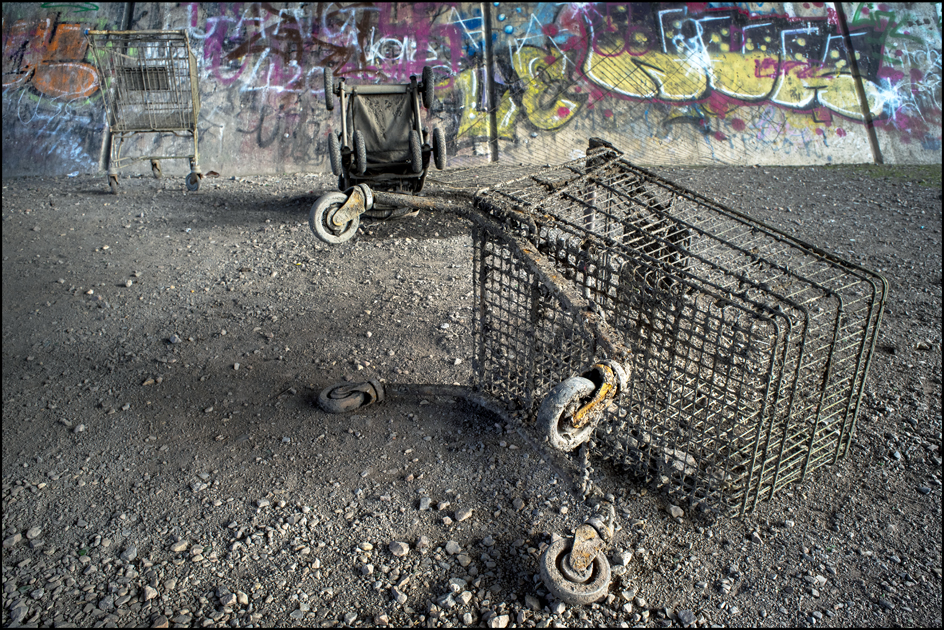
TU-PLEI

A while ago, as I was writing Buried Gods Metal Prophets I often looked back at my childhood games and wondered what they meant then. Whether time has given them a different meaning or not. It might have. And surely while the Guillemot editors worked on the manuscript, there were moments when my siblings’ chasing in the backyard or ‘soldier-soldier’-game felt untouched and sacred. Precious and private.

At first, sacred to me, and later just sweet reminders that childhood play and joy are universal experiences. A child’s laughter and falls and bruises and tears have a collective ‘sameness’ yet our experiences give them unique meaning. A bit like different interpretations of what ‘freedom’ and ‘enjoyment’ are all about. A bit like what being human is all about. After all, war and tragedy, love and disappointment, growth, learning, failure and success are human experiences that repeat themselves despite topological or temporal differences.

TU-PLEI is not just an invitation ‘to play’. It is an invitation to engage with the ludic self then to share the experience with others. TU-PLEI is an exhibition which brings together painting, photography, collage, prints, sculpture and montage from artists with a perceptive and individual interpretation on contemporary playfulness.

Alongside their artwork, there will be poetry from Buried Gods Metal Prophets. FREE entry!
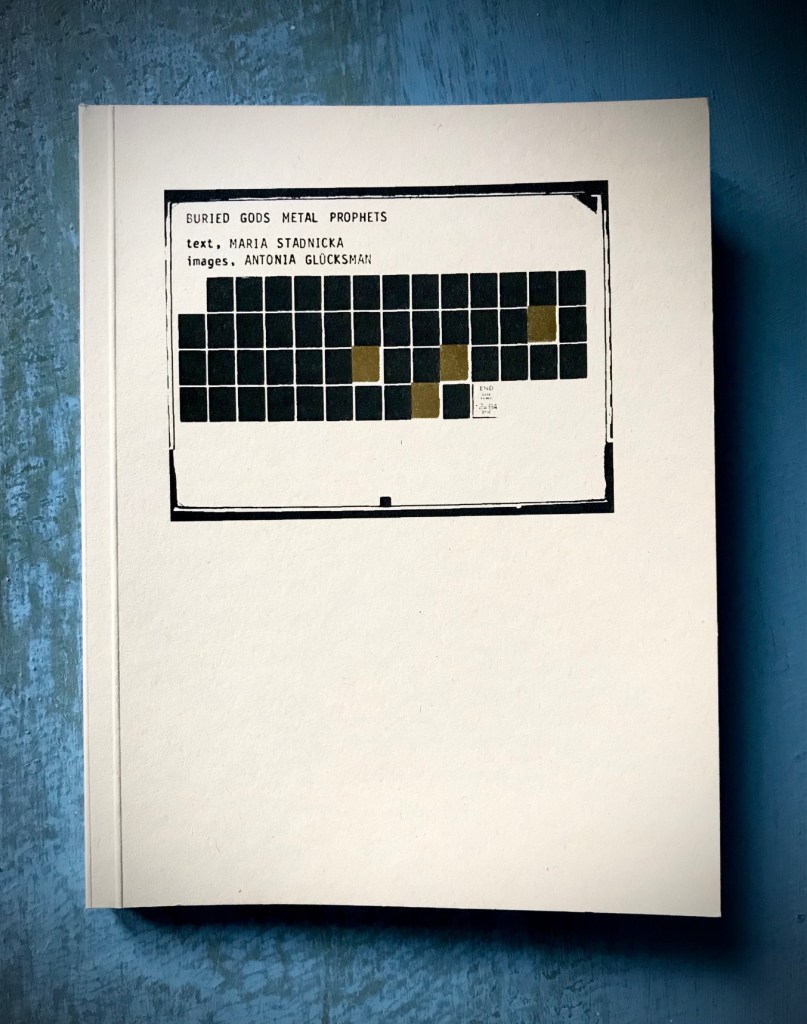
‘Buried Gods Metal Prophets’ 2021

Buried Gods Metal Prophets published by the Guillemot Press, edited by Luke Thompson and Sarah Cave and illustrated by Antonia Glücksman is available here.

The exhibition will be open 20-25 July 2021 at Stroud Brewery.
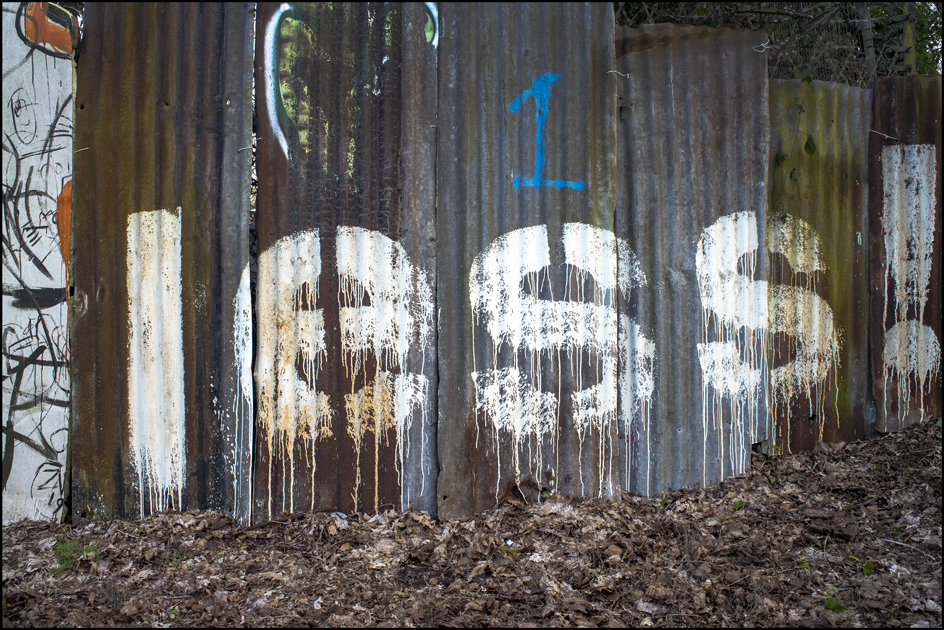
Production Lines

From Samsara (2012) directed by Ron Fricke and produced by Mark Magidson.

Samsara is an American non-narrative documentary originally released at the 2011 Toronto International Film Festival. It was shot in 70mm format, filmed in 25 countries and completed over a period of 5 years.

Maria Stadnicka, May 2021

A Heart Failure

© JStadnicki, Stroud, 2021

At the end of 2020, for the first time in 70 years, Unicef pledged £25,000 to support the community project School Food Matters aimed to provide food to children from 25 British schools over the Christmas holiday. At the time, 3.3 million children were registered for free school meals, an increase of 17% from 2019.

The revelation provoked the public’s consternation and the petition “End Child Food Poverty” initiated by the footballer Marcus Rashford gathered more than 1.1 million signatures. By the time the MPs started debating the petition in Parliament, Rashford had raised £20 million and was already distributing food parcels.

Unicef, UN agency responsible for providing humanitarian aid to children worldwide, said the coronavirus pandemic was the most urgent crisis affecting children since the second world war. The British government’s reluctance to extend the free meals programme led to a significant dip in Boris Johnson’s popularity as the government response to child food poverty was described as “a lot of clothes pegs without a washing line” (BBC, 2020). 

Coming to think of it, free school meals is not the only failed governmental strategy yet it is bruising the national vanity the hardest. We are used to applauding Unicef’s interventions in third-world countries not to witnessing the sixth world economy’s inability to feed its own children in a pandemic. Nothing hurts more than being told you are a bad parent, that you care more about haircuts, the next holiday abroad, the pub opening hours, than about your children’s lunch at school. Being told you are bad at parenting is one thing but admitting it willingly is something else altogether. It’s not about recognising a systemic failure, it is simply admitting that your heart is failing.

Britain, your heart is failing. The core which supports your social systems needs an infusion of compassion and empathy; it needs radical intervention beyond statistical progress, beyond doctrine, beyond sneaky text messages exchanged between “the high and the mighty.”

This intervention won’t be generated by an individual tick in black ink smeared on voting ballots next week. I wish it was that simple. Passing the responsibility higher up the power chain has led to a tacit collective culpability which feels comfortable justifying the existence of food banks. Exercising democracy at a voting station will not transform our society since one million signatures on the petition initiated by Marcus Ashford has done nothing to eradicate child poverty in Britain. It gave us all a pat on the back, the illusion of possibility, as we returned to our post-lockdown revenge spending spree.

And that’s that. Things are almost back to normal while our collective actions give the measure of our collective consciousness. Since the lockdown ended, searches on ebay for ‘high heels’ surged 53% overnight, according to EBay Ads UK. Meanwhile searches for ‘clutch bag’ made by shoppers rose 55% and the sale of ‘hoop earrings’ and ‘fake eyelashes’ increased by 25%. In a couple of months, the summer holiday will mark the end of free school meals and the beginning of a national barbeque season. 

© Maria Stadnicka, April 2021.

Exodus. Chapter Ten. Paragraph Four.

© JStadnicki, Factory MMXXI, Gloucestershire

I am seven, I have committed a crime and I am going to prison where my brother won’t visit for fear of being locked up as well. My mates say if I stare at the classroom walls Mister Williams can’t read my thoughts; a plaster-god weaved a shield around my body that made me invisible.

Open your Bible at ‘Exodus’ chapter ten, paragraph four, he says.

[…and Moses answered: Oh, God, I am slow of speech…]

I spent so long in the company of my laptop that I am becoming a keyboard. I jump over squares in conversation when real things are the wrong way around. They are so loud it is impossible to miss them even if I can barely see at all. Each shortcut leads to a mistake I had made, to a crime I will commit. 

Press “space bar” to be born.

Press “escape” to swear in emojis.

I bear the weight of a full stop God’s tongue drops on my back. I trusted God to wake me up for school with a packed lunch. At breaktime I hear rumbling and my heartbeat. Mister Williams warned me: when you get upset your heart grows a claw which pokes at the ribcage until you pass out. 

To avoid passing out, I have stolen a girl’s lunchbox. I am a thief who will go to prison and die hungry.

How do you plead? Guilty or not guilty?

It gets lighter. I eat my past in small bites and praise the Lord. 

© Maria Stadnicka, April 2021

Mslexia reviews ‘Buried Gods Metal Prophets’

‘Stadnicka’s fourth collection is inspired by the experiences of her siblings who lived in a Romanian children’s home during the time (1967-1989) when the Communist Party banned contraception and abortion. Around 12 million illegal abortions took place and over 250,000 children were placed in care homes and orphanages. The collection also draws on Stadnicka’s experiences as a teacher with HIV-positive children at a Romanian orphanage, and on interviews with women who performed illegal abortions. The book explores the effects of trauma and state oppression, as well as the realities of social, political and historical crises.
Stadnicka’s writing has a disquieting quality, which may be due in part to its difficult subject matter as well as the author’s own lived experience. The language is precise and austere, often relating shocking detail in a deadpan tone. ‘Radioactive milk’ relates how ‘One night / the curse shoots out of her womb / and starts walking. / For some reason / the newly born survives’. The book explores the tragic voices of both staff and abandoned children at the orphanages. One poem, written from the perspective of a child with AIDS, ends heartbreakingly, ‘I feel rather proud. / Someone has given me a name other than dog’. Forms include historical documents, short lyric poems, diary entries and textual experimentation. Keenly observed details add touches of surrealism: ‘The moon falls asleep / above your head’; an angel who ‘stops to light a cigarette’.

Maria Stadnicka is a Romano-British writer, editor and journalist based in Gloucestershire. Previous collections include Somnia and The Geometric Kingdom. Stadnicka is a PhD researcher at the University of the West of England, researching trauma and migration. Recognition for her Romanian work includes the Porni Luceafarul, Convorbiri Literare and T Arghezi awards.

A compelling collection from an independent press. Thee book is beautifully made and designed with haunting illustrations by Antonia Glückman, which enhance its atmosphere of darkness and tragedy.’

© Jennifer Lee Tsai, Mslexia Issue 89, March – May 2021.


Buried Gods Metal Prophets is available here.

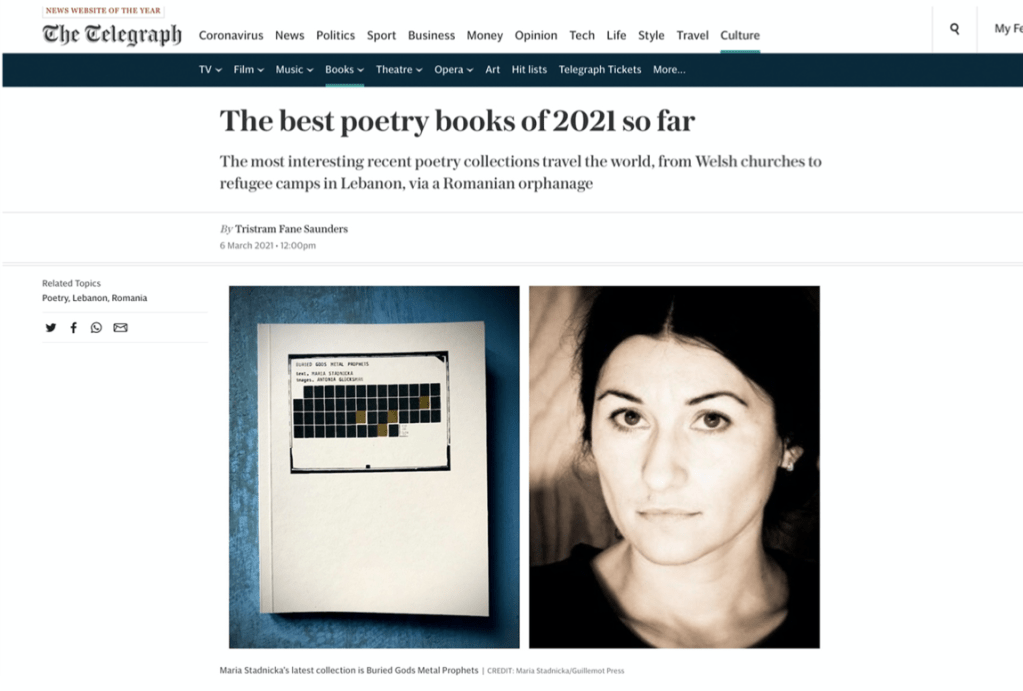
Buried Gods Metal Prophets reviewed in The Telegraph

© Tristram Fane Saunders, The Telegraph, 6 March 2021.

Buried Gods Metal Prophets (2021) is published by Guillemot Press, editors Luke Thompson and Sarah Cave, illustrations and design Antonia Glücksman. The book is available here: https://www.guillemotpress.co.uk/poetry/maria-stadnicka-buried-gods-and-metal-prophets.

Gallery

Locked in winter

This slideshow requires JavaScript.

Vertical Takeoff

On 1st October 1972, having just left the Soviet Union, Joseph Brodsky wrote in the New York Times a five-thousand words article in which he condemned the political climate in Europe, and worldwide, evaluating its dangerous principles and hunger for domination and destruction. Brodsky expressed his scepticism in reference to all ‘political movements’ which he described as ‘structured methods used to avoid personal responsibility.’

Brodsky defended his belief in a different, and superior, system built on ‘personal movements – movements of the soul when a man who looks at himself is so ashamed that he tries to make some sort of change.’ The article, translated from Russian by Carl Proffer, appeared tangled, verbose and aimless; it sounded like so many other disoriented voices coming from dissidents and defectors of the era but those who managed to read it in full recognised its unswerving accuracy in describing a failing world system.

Seamus Heaney called it a moment of literary ‘vertical takeoff’, crucial in establishing the capacity of language to go farther and faster than expected and thereby provide an escape from the limitations and preoccupations of the self.

It was, in itself, a warning signal that politics became a psychological danger for humanity, as it engaged people in external fights with the Evil, which automatically made them begin to identify themselves with the Good. And when mankind begins to consider itself bearer of Good, it slides into self-congratulation. This is a state of complacency which Brodsky, who was stateless in 1972, saw it as the source of everything that was radically bad about people.

Brodsky carefully re-considers the role of an united writing community which is vital in opposing official points of view and which should support ‘personal movements’ by engaging the society in real exercises of reflection and learning. This engagement, however, is built on access to books, not articles about books; direct contact with ideas, not ‘pre-packed’ blurbs.

The PN Review editorial (January 2020) comments on the closure of nearly 800 British libraries over the past ten years. The Trump era defines how we conduct literature not only politics. ‘The triumph of the tweet’ reduces our engagement with books to a suite of emoticons, in which the responsibility for personal engagement with ideas is a constant forward-re-tweet and a sum of likes. Bring me someone who sits down to read War and Peace or a five-thousand words article in the New York Times. I’ll be either their friend or their follower.

© Maria Stadnicka 2021

[‘Vertical Takeoff’ was published in International Times on 25/01/2020.]


Brodsky, J. (1972) ‘A writer is a lonely traveler’. New York Times, 1st October 1972. Available here.

Brodsky, J. (1997) On Grief and Reason. Essays, London: Penguin Books.

PNR, January-February 2020, vol. 46, no.3. Available here.

Hermit Age

When I get lonely, I visit my local tip. Apart from Wednesdays, I am guaranteed to find someone about, willing to help me get rid of a load of stuff which, up to that point, had prevented me from moving on in life. One time I discarded so much of my old junk that back home I noticed the front door sign was gone, and the post box which had my name on it. I got in and a woman I’d never met before was moving about hoovering. She was wearing my shoes.

© Maria Stadnicka January 2021

‘The Geometric Kingdom’ is out now.


In The Geometric Kingdom, Rupert Loydell and Maria Stadnicka write about loss, grief and mourning, and explore how memory, faith and ritual facilitate the relationship between the living and the dead. 

Publisher: Knives, Forks and Spoons Press, UK.

Editor: Alec Newman 


‘Loydell is mining themes that resonate with our times, leading to collaborations with a talented array of fellow poets, allowing for a synergistic pulse of varied views. He and his fellow travelers ask difficult questions and offer open-ended answers through the time-tested holy triad of ethos, logos, and pathos.’

 – Joey Madia, X-Peri

‘Stadnicka’s poetics is one of craftmanship, wherein she carefully walks the tightrope of surreal poetic metaphor and the gritty realism of investigative journalism and broadcasting. Drawing on her experiences in both, Stadnicka’s writing culminates into a distinctly inventive literary landscape.’

 – Bryony Hughes, Stride


The Geometric Kingdom is now available at Knives, Forks and Spoons Press  it can also be ordered on Amazon as well as various local bookshops.