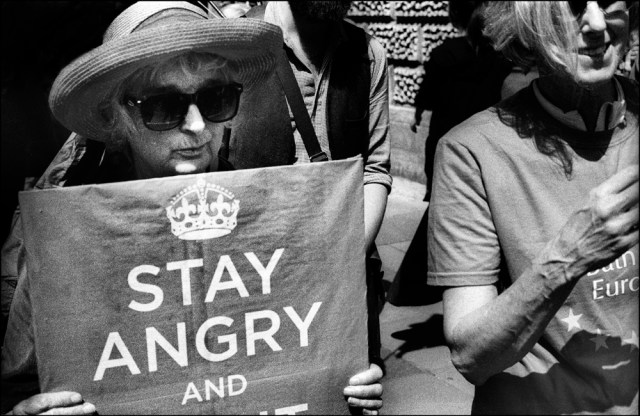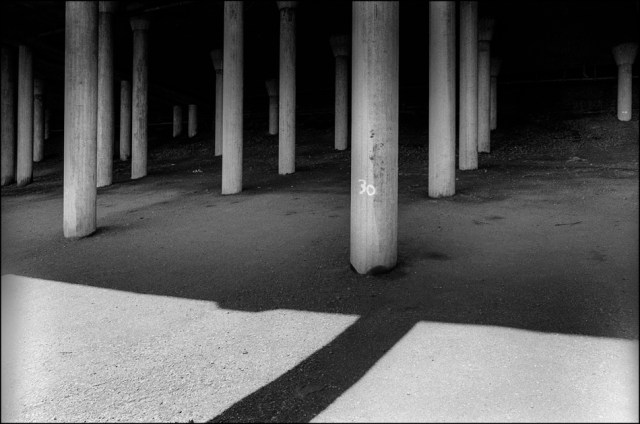
Picket Line

Photography: @JStadnicki 2018

I wanna protest

against Trump but mama says

I’ve got eczema,

there’s ironing left

to do,

the lawn, the beds,

bleach,

scrub the stairlift,

move the mouse-trap from A to B

once I’ve finished with that I should

make a start at

boiling jam.

Seventy-quid-train-fare should feed us all

the week after the picket.

I wanna protest

against mama but Trump

turned the noise right up

in my slum we think

earmuffs should do

she has a whole load of washing

my homework needs checking

for subversive context

a neighbour lost a cat and

she’s now on the phone with 111.

I am not heard.


@Maria Stadnicka, 2018

Graffiti

Illustration: ©Claire Palmer, 2018, for International Times

– unedited preview from ‘The Unmoving’ coming out next month at Broken Sleep Books, published this morning in ‘International Times’:


I imagined the return at the end of my sentence

on a street in Moscow

thinking the worst was already over.


[ more to follow…]


BarKing Powder

When I was a child and lived in an overheated three-bedroom second floor flat, my brothers used to make water bombs. They would fill plastic bags up with cold tap water, tightly knot them, and throw them over the bedroom window every time they would see a pretty girl crossing the alleyway underneath. The water splashed all over the victim and they laughed their heads off, behind curtains. This detail came to mind watching the Brexit process taking place, month by month.

Photography: @JStadnicki, 2018

On reflection, the ‘hahaha-hihihi’ is coming this time from Downing Street as I get on with my form-filling life.

It’s has been hot recently (anyone noticed?!), even I can admit to that, and I’m used to Siberian summers. However, the heated discussions among the ministerial flock have raised the warning level from orange to red as nobody seems to have a clear view-point, nor an exit plan or a rescue package. It feels more and more like we’ve all been hoarded up into a long-haul flight, with a crew of unqualified attendants. In case of crash, it’s going to be ‘each to their own’.

Earlier in the week, the BBC mentioned how the PM is risking a revolt (I wish!) if the ‘type of Brexit she promised is not delivered’. Come on, Duncan, calling the PM ‘insolent’ on Twitter will not bring a velvet revolution. When Tusk issued a ‘last call’ at last week’s summit in Brussels, he didn’t mean your plane to the Maldives was about to take off. He meant business as you were about to sip another cooling lemonade. Last Saturday, a ‘livid’ Gove physically ripped up a report (did he really?!) for a new customs partnership with the EU. Qui prodest?

I get to understand miss Vicky when she said we needed a ‘practical, pragmatic deal that gives certainty to business and trade… not an ideological one’. The only things with it is …. everything on paper stays on paper and, therefore, is ideological. I’m back, for now, to reading Nausea. It makes, by far, a clearer point.

We are about to leave, I’ve got used to the idea by now, but there isn’t a destination on sight. We might find ourselves flying over the European economic space until the engine runs out of fuel. And then, let’s see who’s got a parachute.

©Maria Stadnicka, July 2018

published in ‘International Times’ / 3rd July 2018

Gallery

World Cup Suburbia


Photography: ©John Stadnicki, 2018

Image

New collection, coming out 17th August @ Broken Sleep Books

The Politics of Inevitability and the Art Education

Photograph: ©JStadnicki, 2018

There is no way one can observe the social transformations within a community and society without resorting to strong political clues in order to understand the sources of those transformations. And clearly, when things go wrong, we blame the politics, the legislators, the government. But when the political sphere moves away from the reality of the people it represents, the laws and the policies have no real impact on the wide majority. The decision-making groups have little will to support change, and the economic downturn Britain has been experiencing for over a decade seems to move towards a silent collapse. And nobody appears to take responsibility. The blame placed on the government rules like a shadow, hiding underneath the roots of bad financial decisions, personal greed and managerial incompetence.

Let’s consider the situation the art sector is in at the moment.  The issue came into focus with the news of the devastating fire which, this second time, damaged the Glasgow School of Art beyond repair. There you have £35m down the drain, or rather turned to ashes, and everybody is powerlessly looking at the building asking, in disbelief, ‘how could this be possible’. The fate of the Glasgow School of Art seems, for now at least, sealed by confusion and uncertainty. Who is to blame?

Extrapolating the Glasgow tragedy, we are looking for someone or something to blame for the uncertain fate of hundreds of art schools across the country, which slowly, but surely, are decapitated by unachievable targets and percentages. This time, we encounter another type of devastating fire, which is slowly cooking to ashes the art sector, in general, and the art education, in particular: the drive to achieve the funding targets, the attendance and the achievement rates, the literacy and the numeracy benchmarks. What do they all mean? Certainly, they mean nothing to those involved in the art sector (students, artists, writers, musicians, teachers), but mean everything to those in charge to justify the bureaucracy supporting their livelihoods; bureaucracy which satisfies the pleiades of regulators and inspectors. The focus of this type of education is not the youth’s creativity; it is to produce a nation of self-absorbed adults, ready to slot into whatever social square is allocated to them as soon as they join the education system.

And here we face again another type of politics. The ‘politics of inevitability’ as Snyder eloquently describes it, which makes the art education vulnerable and a victim of the constantly expanding globalisation. Since the mid ‘80s, the way we talk about art has fundamentally changed as well as the way the education system works to serve the economy, under the bright colours of neoliberalism.  One would say, what is the problem with that? There is nothing wrong with expecting profitability, and economic success. There is, though, if the principle on which the profit is based, is wrong.

The education and the arts remain essential social institutions  in a healthy society. They create and preserve what we call our ‘decency’. They remain our ‘sane barometer’ if you like, which supports the configuration of our future and the values this future will act upon.

I remember a recent conversation I had with a head of school who recognised that things have taken a turn for the worse, with the Brexit uncertainty looming, but, as he said, ‘what can one do against a whole government, with a mortgage to pay?’

Here we are again, in the blaming game equation. The well-suited head is back in his leather chair, the young artist is back revising for another maths test. New financial cuts are drowning the hope of an economic recovery and the silence of those suffering its effects sounds more and more like a resigned agreement. Not once we feel that the history allows us to see patterns and to understand that action is a possibility.

History permits us, ‘to be responsible; not for everything, but for something’ as the poet Czeslaw Milosz said. This responsibility has always worked against loneliness and indifference.

©Maria Stadnicka, June 2018, Gloucestershire, UK


Wales. Time spent somewhere other than here.

This slideshow requires JavaScript.

‘It is unfortunately hard to recall our quasi-permanent concern with the future, for on our return from a place, perhaps the first thing to disappear from memory is just how much of the past we spent dwelling on what was to come; how much of it, that is, we spent somewhere other than where we were.’  (de Botton, 2002)

Photography: ©John Stadnicki, 2018

Mickey Mouse at the royal wedding, International Times


Live interview with Mikey Mouse, @International Times

©Maria Stadnicka, May 2018

In Case You Look For Me

Photography: Copyright J. Stadnicki, 2018

Gallery

Sketches