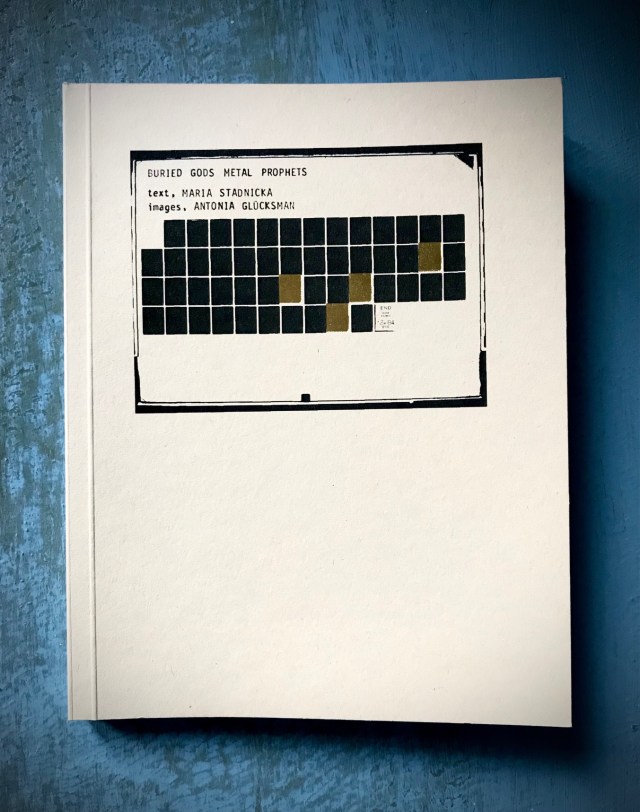
“Stark, bleak but also beautiful-haunting” / “Buried Gods Metal Prophets” reviewed by Mike Ferguson

There are many voices in these poems about degradation, fight, resilience and defeat. There is defiance, and some ‘needs-must’ wry humour, but in the regular resignation – a kind of strength when that is all you can produce – it is deeply despairing. That the collection begins with Radioactive Milk, a poem that births the horrors of both its (and the whole book’s) reality and symbolism, it is not surprising there’s a dark portrayal of suffering and at best some kind of basic survival.

The other ‘voice’ – one that works with and against the poetic – is that contained in the documents and notes and reports and diagrams and other similar that set the scene/s of orphanage, alienation, abuse, doctors/medical, government, history and so on. Stadnicka’s poetry has such a startling ability to move into the expanse beyond this – where it needs to be exploring in and around the actual – that these other reminders are anchors to what should be an extraordinary context, but is in human history a bleak norm.

There are so many threads I would like to follow and unravel here, but I have only just finished a complete read and know I will want but also have to return to begin tying these together. I don’t mean that’s a necessity to be engaged and moved by the full narrative of these memorable poems. I mean that is what I want to do, because I am so engaged. To share a few impressions: the child Stupid (as so-called, though clearly not as the observations reveal) talks of pulling teeth – having to pull out one’s own teeth – and so when this reference point appears again in a poem like Sister’s Night Shift, it resonates in its differing reveal, […]

Full review available here.

© Mike Ferguson, 2021.


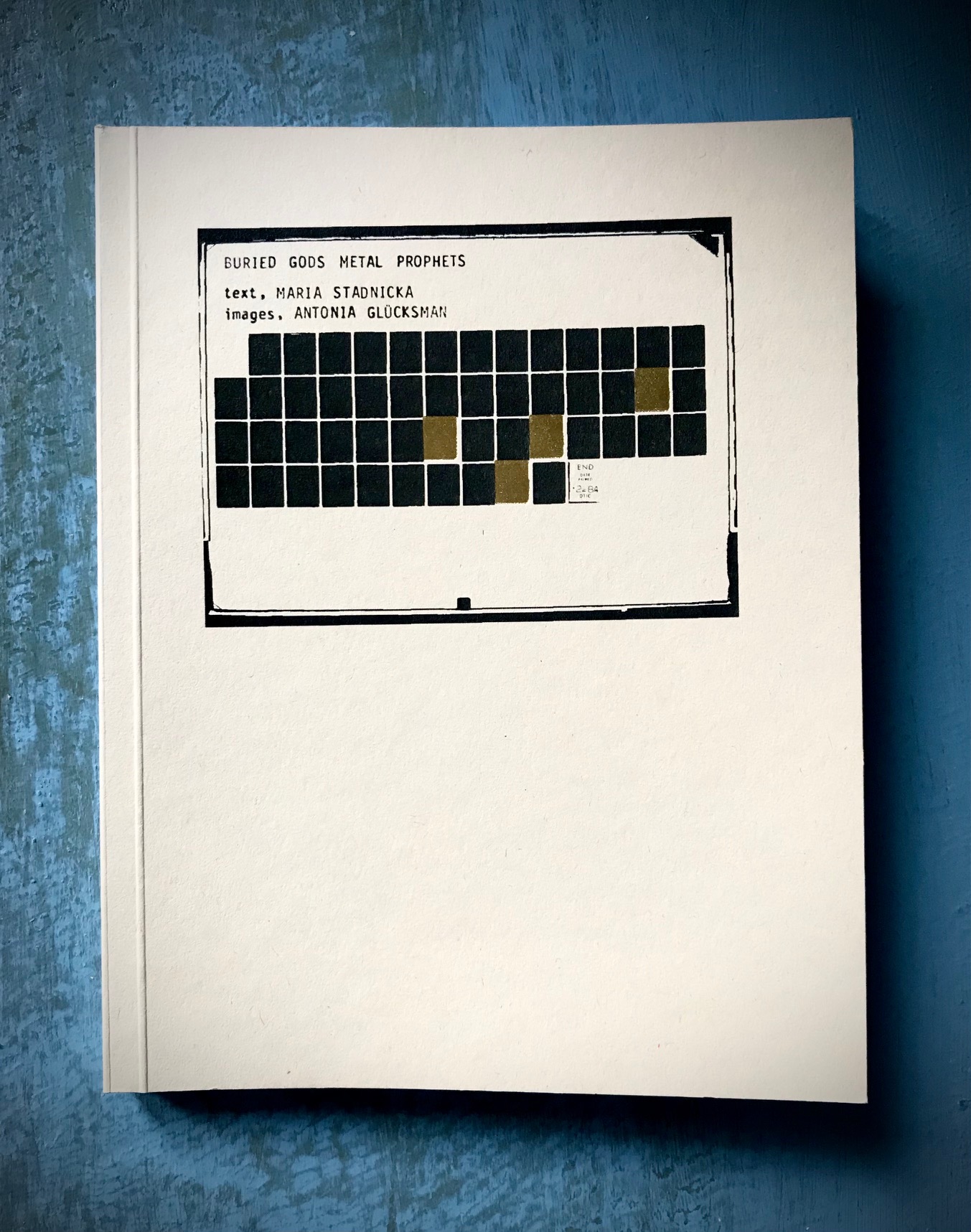
Buried Gods Metal Prophets published by Guillemot Press and illustrated by Antonia Glücksman is available here.

Mslexia reviews ‘Buried Gods Metal Prophets’

‘Stadnicka’s fourth collection is inspired by the experiences of her siblings who lived in a Romanian children’s home during the time (1967-1989) when the Communist Party banned contraception and abortion. Around 12 million illegal abortions took place and over 250,000 children were placed in care homes and orphanages. The collection also draws on Stadnicka’s experiences as a teacher with HIV-positive children at a Romanian orphanage, and on interviews with women who performed illegal abortions. The book explores the effects of trauma and state oppression, as well as the realities of social, political and historical crises.
Stadnicka’s writing has a disquieting quality, which may be due in part to its difficult subject matter as well as the author’s own lived experience. The language is precise and austere, often relating shocking detail in a deadpan tone. ‘Radioactive milk’ relates how ‘One night / the curse shoots out of her womb / and starts walking. / For some reason / the newly born survives’. The book explores the tragic voices of both staff and abandoned children at the orphanages. One poem, written from the perspective of a child with AIDS, ends heartbreakingly, ‘I feel rather proud. / Someone has given me a name other than dog’. Forms include historical documents, short lyric poems, diary entries and textual experimentation. Keenly observed details add touches of surrealism: ‘The moon falls asleep / above your head’; an angel who ‘stops to light a cigarette’.

Maria Stadnicka is a Romano-British writer, editor and journalist based in Gloucestershire. Previous collections include Somnia and The Geometric Kingdom. Stadnicka is a PhD researcher at the University of the West of England, researching trauma and migration. Recognition for her Romanian work includes the Porni Luceafarul, Convorbiri Literare and T Arghezi awards.

A compelling collection from an independent press. Thee book is beautifully made and designed with haunting illustrations by Antonia Glückman, which enhance its atmosphere of darkness and tragedy.’

© Jennifer Lee Tsai, Mslexia Issue 89, March – May 2021.


Buried Gods Metal Prophets is available here.

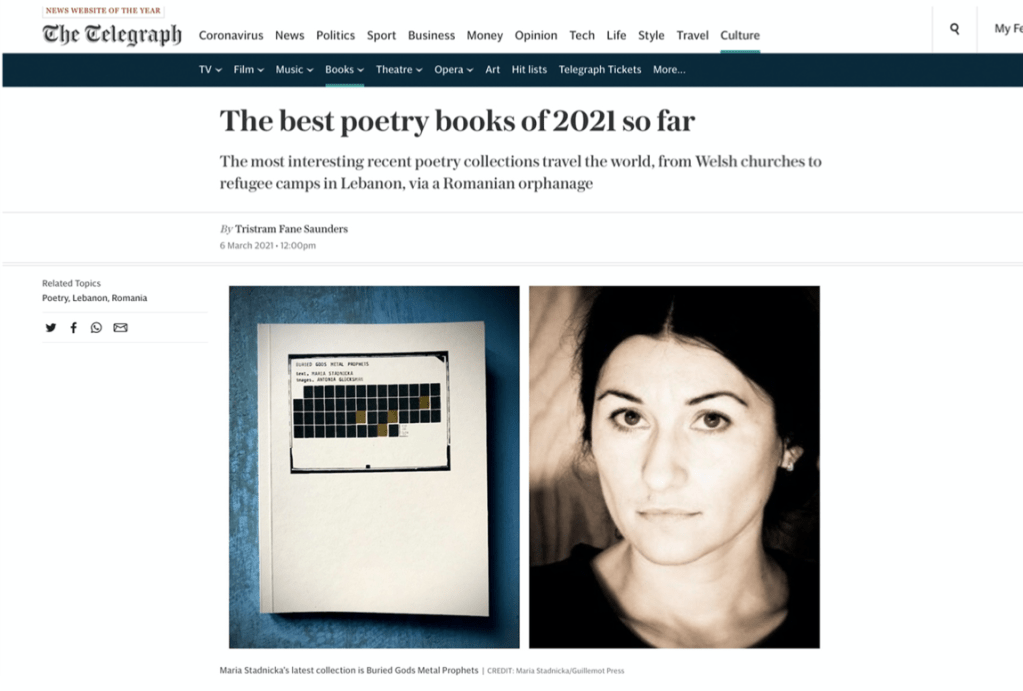
Buried Gods Metal Prophets reviewed in The Telegraph

© Tristram Fane Saunders, The Telegraph, 6 March 2021.

Buried Gods Metal Prophets (2021) is published by Guillemot Press, editors Luke Thompson and Sarah Cave, illustrations and design Antonia Glücksman. The book is available here: https://www.guillemotpress.co.uk/poetry/maria-stadnicka-buried-gods-and-metal-prophets.

‘Buried Gods Metal Prophets’ is now available.

Buried Gods and Metal Prophets is based on Stadnicka’s experience as a teacher at St. Stelian Orphanage, north Romania, which cared for three hundred children diagnosed with HIV and AIDS. Exposing the reality of living in state care during the Cold War, it explores the spectre of political and human tyranny that can contribute to a generational socio-cultural trauma. Buried Gods Metal Prophets explores childhood experiences during the Cold War in Romania following the Decree 770 imposed by the Communist Party in 1966. Issued as a measure meant to stimulate the population growth, the disastrous Decree 770 banned contraception and abortion, while awarding women with more than five children an Order of the Heroine Mother. As a result, an estimated twelve million illegal abortions took place between 1967 and 1989 while over 250,000 children were placed in orphanages or care homes.

Stadnicka builds a polyphonic poetic documentary inspired by Julia Kristeva’s idea that poetry can establish ‘space and infinity’ beyond the restriction of linear poetics. The juxtaposition of narratives builds a world in which the omnipresent voice of the government echoes in the mechanised communication between the state and the individual, in a society where the private ownership of a typewriter without state permission, meant prison sentence.

‘Buried Gods Metal Prophets’ 2021
Image © Antonia Glücksman 2021, in Buried Gods Metal Prophets published by Guillemot Press, 2021, UK.

‘UK-based Romanian poet Maria Stadnicka’s forthcoming Buried Gods Metal Prophetspublished by Guillemot Press, is an astonishing collection of poems, and a testament to the tens of thousands of children who grew up in Romanian orphanages under Nicolae Ceaușescu. Bringing together historical documents of the era, lines of other authors with her “censoring” interventions, and Stadnicka’s own moving poetry, this is the poet’s fourth collection both written and published in English.’ (Paula Erizanu, The Calvert Journal, 2021)

The full article is available here: https://www.calvertjournal.com/articles/show/12466/romanian-english-poetry-ceausescu-orphans-buried-gods-metal-prophets-maria-stadnicka

Buried Gods Metal Prophets (2021) is published by Guillemot Press. Editors: Luke Thompson and Sarah Cave. Design and illustration: Antonia Glücksman. The book is available here.

Gallery

Locked in winter

This slideshow requires JavaScript.

Vertical Takeoff

On 1st October 1972, having just left the Soviet Union, Joseph Brodsky wrote in the New York Times a five-thousand words article in which he condemned the political climate in Europe, and worldwide, evaluating its dangerous principles and hunger for domination and destruction. Brodsky expressed his scepticism in reference to all ‘political movements’ which he described as ‘structured methods used to avoid personal responsibility.’

Brodsky defended his belief in a different, and superior, system built on ‘personal movements – movements of the soul when a man who looks at himself is so ashamed that he tries to make some sort of change.’ The article, translated from Russian by Carl Proffer, appeared tangled, verbose and aimless; it sounded like so many other disoriented voices coming from dissidents and defectors of the era but those who managed to read it in full recognised its unswerving accuracy in describing a failing world system.

Seamus Heaney called it a moment of literary ‘vertical takeoff’, crucial in establishing the capacity of language to go farther and faster than expected and thereby provide an escape from the limitations and preoccupations of the self.

It was, in itself, a warning signal that politics became a psychological danger for humanity, as it engaged people in external fights with the Evil, which automatically made them begin to identify themselves with the Good. And when mankind begins to consider itself bearer of Good, it slides into self-congratulation. This is a state of complacency which Brodsky, who was stateless in 1972, saw it as the source of everything that was radically bad about people.

Brodsky carefully re-considers the role of an united writing community which is vital in opposing official points of view and which should support ‘personal movements’ by engaging the society in real exercises of reflection and learning. This engagement, however, is built on access to books, not articles about books; direct contact with ideas, not ‘pre-packed’ blurbs.

The PN Review editorial (January 2020) comments on the closure of nearly 800 British libraries over the past ten years. The Trump era defines how we conduct literature not only politics. ‘The triumph of the tweet’ reduces our engagement with books to a suite of emoticons, in which the responsibility for personal engagement with ideas is a constant forward-re-tweet and a sum of likes. Bring me someone who sits down to read War and Peace or a five-thousand words article in the New York Times. I’ll be either their friend or their follower.

© Maria Stadnicka 2021

[‘Vertical Takeoff’ was published in International Times on 25/01/2020.]


Brodsky, J. (1972) ‘A writer is a lonely traveler’. New York Times, 1st October 1972. Available here.

Brodsky, J. (1997) On Grief and Reason. Essays, London: Penguin Books.

PNR, January-February 2020, vol. 46, no.3. Available here.

‘Buried Gods Metal Prophets’ out on 11 Feb. 2021

Buried Gods Metal Prophets published by the Guillemot Press, UK.

Editors: Luke Thompson and Sarah Cave

Design and illustrations: Antonia Glücksman

Free online launch on 11 Feb. 2021 at 7pm. Please register using the Guillemot’s Events Page which is available here: https://www.guillemotpress.co.uk/events/11th-february-book-launch-maria-stadnicka-featuring-susie-campbell.

About Buried Gods Metal Prophets:

Maria Stadnicka’s latest poetry collection Buried Gods Metal Prophets is inspired by the experiences of her siblings, who lived in a Romanian children’s home between 1978-1987. This was the period of Romania’s Communist Party’s disastrous ‘Decree 770’, which banned contraception and abortion, at the same time as awarding women with more than five children an ‘Order of the Heroine Mother’. As a result, an estimated twelve million illegal abortions took place between 1967 and 1989 and over 250,000 children were placed in orphanages or care homes.

Stadnicka builds a polyphonic poetic documentary inspired by Julia Kristeva’s idea that poetry can establish ‘space and infinity’ beyond the restriction of linear poetics. The juxtaposition of narratives builds a world in which the omnipresent voice of the government echoes in the mechanised communication between the state and the individual, as well as in the control over the process of information dissemination in a climate where the private ownership of a typewriter without state permission, meant prison sentence.

Buried Gods Metal Prophets is based on her personal experience when working as a teacher at St. Stelian Orphanage which cared for three hundred children diagnosed with HIV and AIDS. Exposing the reality of living in state care during the Cold War, it explores the spectre of political and human tyranny that can contribute to a generational socio-cultural trauma. Children are called by numbers, not by names, and even the letters they write to Santa Claus are subject to censorship.

The creative process was informed by interviews with family members, and research around childhood trauma, neglect and child language development. The book responds to what Sartre calls literary ‘commitment and substance of enterprise’, looking at survival as an act of defiance.

January 2021

Hermit Age

When I get lonely, I visit my local tip. Apart from Wednesdays, I am guaranteed to find someone about, willing to help me get rid of a load of stuff which, up to that point, had prevented me from moving on in life. One time I discarded so much of my old junk that back home I noticed the front door sign was gone, and the post box which had my name on it. I got in and a woman I’d never met before was moving about hoovering. She was wearing my shoes.

© Maria Stadnicka January 2021

‘The Geometric Kingdom’ is out now.


In The Geometric Kingdom, Rupert Loydell and Maria Stadnicka write about loss, grief and mourning, and explore how memory, faith and ritual facilitate the relationship between the living and the dead. 

Publisher: Knives, Forks and Spoons Press, UK.

Editor: Alec Newman 


‘Loydell is mining themes that resonate with our times, leading to collaborations with a talented array of fellow poets, allowing for a synergistic pulse of varied views. He and his fellow travelers ask difficult questions and offer open-ended answers through the time-tested holy triad of ethos, logos, and pathos.’

 – Joey Madia, X-Peri

‘Stadnicka’s poetics is one of craftmanship, wherein she carefully walks the tightrope of surreal poetic metaphor and the gritty realism of investigative journalism and broadcasting. Drawing on her experiences in both, Stadnicka’s writing culminates into a distinctly inventive literary landscape.’

 – Bryony Hughes, Stride


The Geometric Kingdom is now available at Knives, Forks and Spoons Press  it can also be ordered on Amazon as well as various local bookshops. 


Yes, it is all a snapchat but I take it seriously.

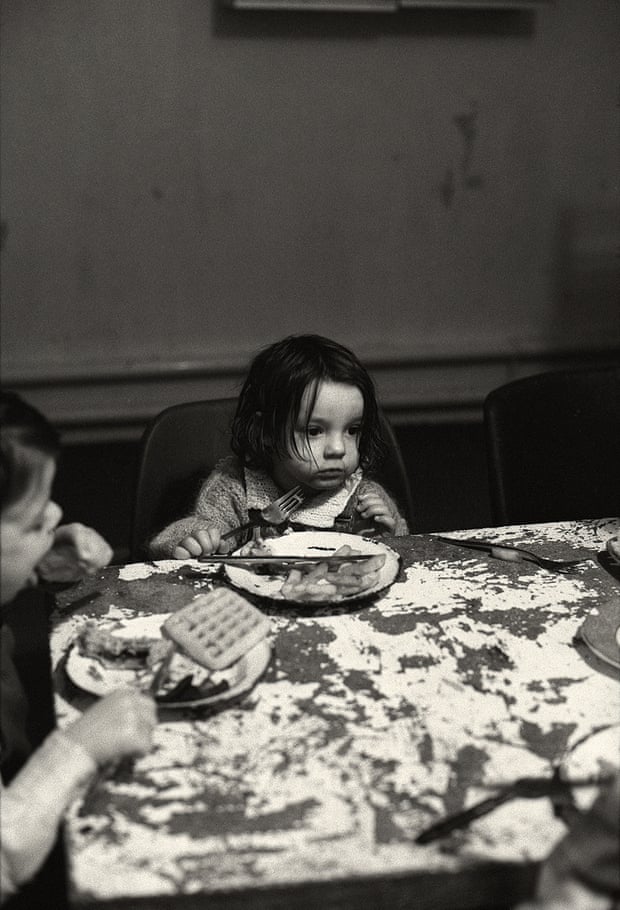
Katrina aged four (1992). © Photograph: Craig Easton / Published in The Guardian on 14 Nov 2020

I am seven and have committed a crime. And I am going to prison where my brother won’t visit for fear of being locked up as well. Someone says that if you stare at the classroom walls long enough, Mister Williams can’t read your thoughts because God, hidden in the plaster, has built a shield around your body which makes you invisible.

I trust God to wake me up with a packed lunch I can carry to school, but at break-time all I hear is rumbling and heartbeats. Grandfather warned me that when you get upset your heart grows a claw which pokes at your ribcage until you pass out. And to avoid passing out, I’ve stolen a girl’s lunchbox. I am a thief who will go to prison and die hungry.

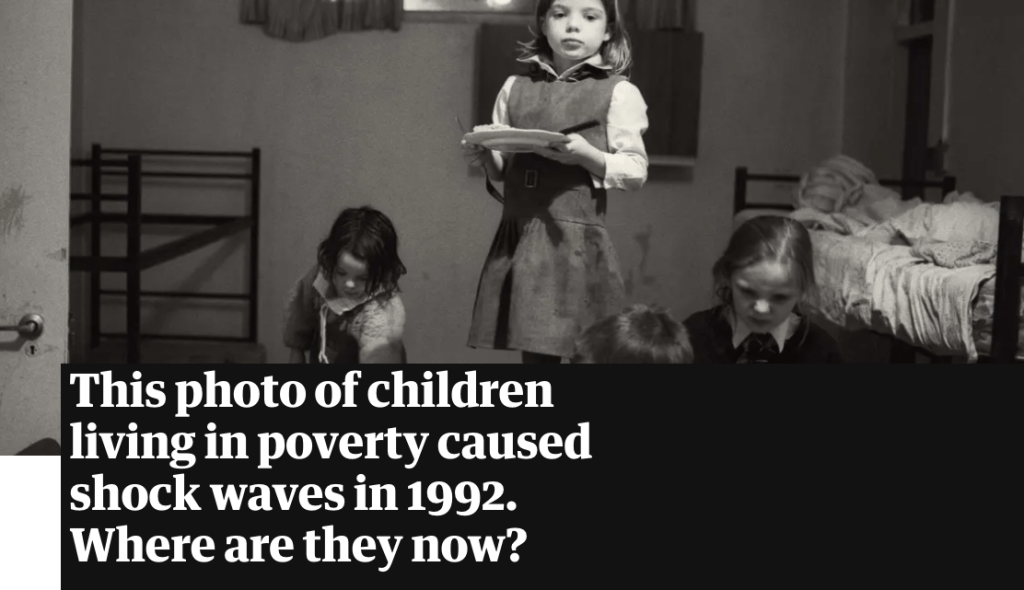
© Jack Shenker The Guardian 14 Nov 2020

The article can be accessed here: https://www.theguardian.com/society/2020/nov/14/this-photo-of-children-living-in-poverty-caused-shock-waves-in-1992-where-are-they-now

Maria Stadnicka, 14th November 2020, UK