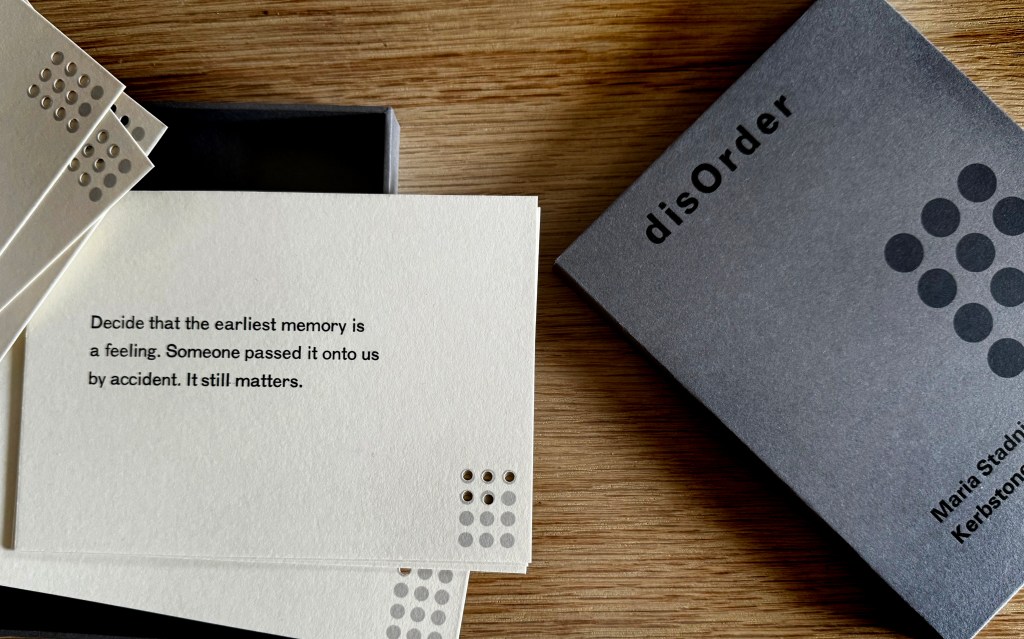
Decide that the earliest memory is
a feeling. Someone passed it onto us
by accident. It still matters.
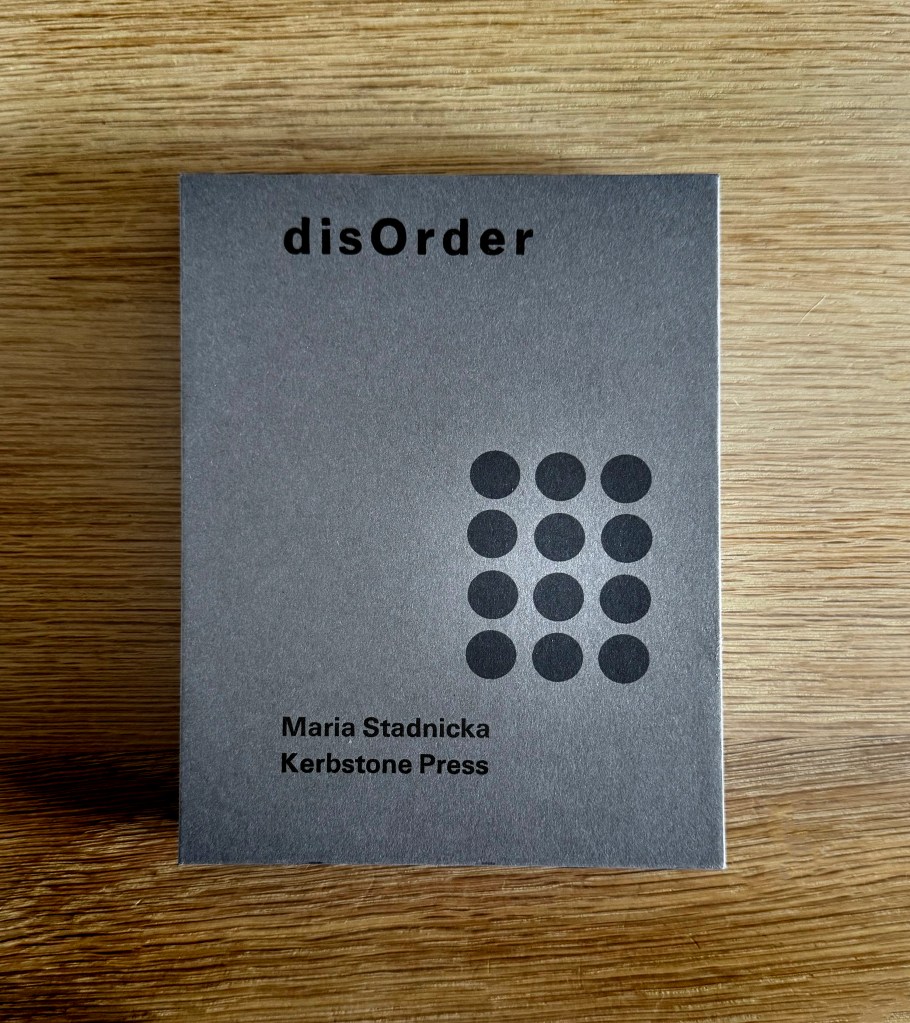
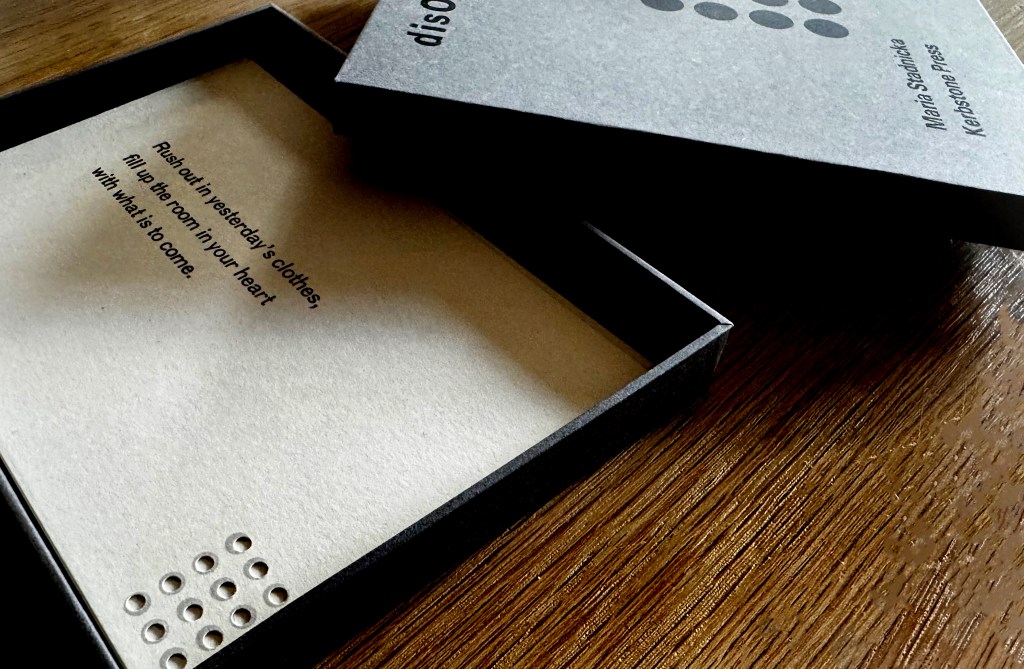
disOrder is a new project in collaboration with Andrew Morrison Books and produced by Kerbstone Press. It is an artist book in a box, and it is coming out at the Bristol Artist’s Book Event (B.A.B.E.) this weekend. The event will take place at the Bower Ashton Gallery, University of the West of England, 29-30 June, 11am – 5pm. The event is free and there will be hundreds of other books to see if you are in the neighbourhood. You can find more information here.
One. Stand in a glass dolls house. Turn
the key and a musical box opens.
Puppets in spiral – long days of grass.

Two. Walk to the top of a hill, watch over
those awoken by star lights. When we sing,
we do not use words.

Three. Hold tight on to the back of
a minotaur; in the labyrinth we guard
the source of our rivers.

Four. Swimming lessons. Breathing
practice for later life. Check
the sea level at regular intervals.

Five. Decide that the earliest memory is
a feeling. Someone passed it onto us
by accident. It still matters.

Six. Find a safe place, give it a nickname
or at least get a colour to fit with
the things we tell ourselves.

Seven. Pull a curtain over the ruins of
here. Convince ourselves: all we need
is just round the corner.

Eight. Travel by car, boat, bus;
the motion sickness for changing
our minds always at the last minute.

Nine. Count empty chairs at departure
gates. Fold the rest of the day
in half then gift it to strangers.

Ten. Arrivals happen when there is
no luggage left to pick up. All forgiven
out of necessity.

Eleven. The railway platform keeps
changing numbers. Watch closely
notice boards in an antechamber.

Twelve. Rush out in yesterday’s clothes,
fill up the rooms in our heart
with what is to come.
During a heatwave, visitors are
forbidden beyond the reception desk.

Breathing machines run on batteries
after midnight nurses rush out

on cigarette break. There is
a sudden drop in humidity

with the scream of a new-born
dug out of the womb by hand.

Outside the hospital, a man walks
between candles like into a forest

delivering flowers to the maternity.
Alley cats rummage through garbage,

wish him good luck. Staff change shifts
back at depot for deep-cleaning.

Summer rainwater washes away
night traffic blood puddles.
24th April 2020. Britain just passed the peak. A live broadcast from Downing Street shows an increase of over 5,500 cases of COVID-19 in 24 hours. It is lower than earlier in the week and there are more good news. The PM has made a full recovery from his encounter with the virus and he is now expected back in the swing of things.
Analysing newspapers’ front pages from 24th April 2020, I find headlines suggesting how a ‘grateful Britain’ (Daily Mirror) is slowly ‘taking back control’ (The Daily Telegraph), with the help of ‘mass testing to get Britain back on her feet’ (Daily Express). At the same time, hospitals are struggling with significant PPE shortages, with ‘failings in the privately run virus test centres’ (The Guardian) and are ‘running out of dialysis kits’ (The Independent).
A snapshot of the ‘new normal’ (The Scotsman) in April, when things are bad and better at the same time. The sigh of relief from governmental departments is so loud, I can almost hear it from the Midlands in the lockdown quietness.
Weather is good, but the angst caused by the ’emergency stop on economy’ is wearing many out. As my professional and social life move online, days and nights blend into each other, in a confusing melange of obsessive handwashing, sleeplessness, overeating and virus paranoia. I would believe anything as long as it brings hope.
The worst has passed and social media takes comfort in the heavily quoted words of Pastor Olawale Daniel who prophetically anticipates the arrival of ‘a time to go back to the drawing board and rewrite the next phase of our existence’.
I admit I have not heard of Pastor Olawale before the pandemic and, checking his website, I am still unable to trust the source but for a while his quote goes viral on social media. Maybe it speaks to a yearning for social change, in a moment when, having lockdown time for reflection, we realise that we have been going in the wrong direction.
25th May 2020. I’ve already been introduced to the science behind the R number. The press conference in Downing Street is chaired by the PM himself who announces an increase in number of COVID-19 cases with only 1,600 in 24 hours. Britain’s records show that 36,900 people died infected with COVID-19, but I’m re-assured that things are ‘being controlled’.
Unfortunately, trust in the government’s concerted narrative ‘together against the virus’ suffers a big blow following the Cummings-gate media revelations.
Newspapers’ front pages explain how the PM’s aide, ‘a cheat’ (Daily Mirror), offers ‘no apology, no explanation’ (The Guardian) for breaking the lockdown rules. While some newspapers report that ‘he acted responsibly, legally, and with integrity’ (The Daily Telegraph), others call for the ‘aide’s sacking’ (The Scotsman) and the public opinion begins to split, reigniting the arguments which fuel the narrative ‘them and us’. My professional and social life are still booming online, weather is good, and then something else happens.
George Floyd is killed in Minneapolis at 9.07pm. Britain is asleep (3.07am) and about to wake up to an updated version of the ‘new normal’; a social normality forced back to the ‘drawing board’ by the inequality and the injustice which stained our system before the COVID-19 pandemic, and our systems before that, and even earlier than that, as back as history can remember.
7th June 2020. The statue of Edward Colston is toppled and removed by protesters supporting the ‘George Floyd Movement’ in Bristol. The British Home Secretary points the finger at the destructive ‘mobsters’ and the House of Commons heats up with MPs recognising the urgent need to improve our education system. We have not learned enough from the past, nor thought enough about a future free from racism, discrimination and injustice. At this point, volume goes up in my headphones.
It is a mistake. A mistake, for I can hear Sam Terry (MP for Ilford South) saying how UK universities must be:
valued as part of the frontline response to the coronavirus pandemic, […] and recognised for the role they can play in their local economies in terms of retraining and reskilling their local workers during any recovery from the pandemic. (2020, p.1)
The hope for fresh beginning in the ‘new normal’ gets crushed. Shouldn’t universities be recognised for all their roles, for their contribution to developing critical thinking and creativity, science as well as arts and humanities? If not, then what is the point in having higher education in the first place?
With philosophy, literature and art courses being scrapped in many British universities, public libraries closing, an art sector barely surviving under the new rules of social distancing, our children’s chance to reflect on and to learn from past mistakes is significantly undermined. Not that economic recovery is irrelevant, far from it; but looking at the underlying societal disease caused by ‘outcomes’, it seems that we are moving backwards. Almost as back as 1935 when Bertrand Russell observed a similar symptomatic failure in the education system:
Educational commissions point out that fifteen hundred words are all that most people employ in business correspondence, and therefore suggest that all others should be avoided in the school curriculum. (1935, p.34)
Russell criticised the education system tasked to avoid ‘useless’ knowledge, without practical applicability and immediacy, pointing out the insurmountable value of philosophy and literature, for instance, in creating better visions for the future.
Surely in almost a century we moved beyond fifteen hundred words, surely our world-leading higher education system looks nothing like the system described by Russell in 1935:
Knowledge everywhere is coming to be regarded not as a good in itself, or a means of creating a broader and human outlook on life in general, but as merely an ingredient in technical skill. Educational establishments are not allowed to spend their money as they like, but must satisfy the State that they are serving a useful purpose by imparting skill and instilling loyalty. (In Praise of Idleness, 1935, p.38)
Writing In Praise of Idleness, Russell had the experience of the Great Depression. The Stock Market Crash followed in 1939. Despite his opposition to war, Russell witnessed how a social system, skilled by education, was unable to solve the crisis of the 20th century in any other way but war.
Nietzsche insists that a person must
find at least one truth before a good
night sleep. A terrible prospect
considering how facts come about,
with their own sets of variables.
wind force,
speed in metres per second,
momentum at impact with a surface,
temperature
and friction between molecules
Ninety-degree angles do not exist
in real life. Until now we have been tricked
by scientists into believing in verticality.
Meanwhile they build a simplified version
of the world, a dummy manual, if you like,
for funding purposes.









 Maria Stadnicka