Vertical Takeoff

On 1st October 1972, having just left the Soviet Union, Joseph Brodsky wrote in New York Times a five-thousand words article in which he condemned the political climate in Europe, and worldwide, evaluating its dangerous principles and hunger for domination and destruction. Brodsky expressed his scepticism in reference to all ‘political movements’ which he described as ‘structured methods used to avoid personal responsibility.’

Brodsky defended his belief in a different, and superior, system built on ‘personal movements – movements of the soul when a man who looks at himself is so ashamed that he tries to make some sort of change.’ The article, translated from Russian by Carl Proffer, appeared tangled, verbose and aimless; it sounded like so many other disoriented voices coming from dissidents and defectors of the era, but those who managed to read it in full recognised its unswerving accuracy in describing a failing world system.

Seamus Heaney called it a moment of literary ‘vertical takeoff’, crucial in establishing the capacity of language to go farther and faster than expected and thereby provide an escape from the limitations and preoccupations of the self.

It was, in itself, a warning signal that politics became a psychological danger for humanity, as it engaged people in external fights with the Evil, which automatically made them begin to identify themselves with the Good. And when mankind begins to consider itself bearer of Good, it slides into self-congratulation. This is a state of complacency which Brodsky, who was stateless in 1972, saw it as the source of everything that was radically bad about people.

Brodsky carefully re-considers the role of a united writing community which is vital in opposing official points of view and which should support ‘personal movements’ by engaging with our society in real exercises of reflection and learning. This engagement, however, is built on access to books, not articles about books; direct contact with ideas, not ‘pre-packed’ blurbs.

The latest PN Review editorial comments on the closure of nearly 800 British libraries over the past ten years. The Trump era defines how we conduct literature not only politics. ‘The triumph of the tweet’ reduced our engagement with books to a suite of emoticons, in which the responsibility for personal engagement with ideas is a constant forward-re-tweet and a sum of likes. Bring me someone who sits down to read War and Peace or a five-thousand words article in New York Times. I’ll be either their friend or their follower.

© Maria Stadnicka 2020

[‘Vertical Takeoff’ was published in International Times on 25/01/2020.]


Brodsky, J. (1972) ‘A writer is a lonely traveler’. New York Times, 1st October 1972. Available here.

Brodsky, J. (1997) On Grief and Reason. Essays, London: Penguin Books.

PNR, January-February 2020, vol. 46, no.3. Available here.


Art Climate

Sculpture © Khalil Chishtee

Artist Khalil Chishtee creates work from discarded plastic bags, expressing feelings of sorrow, dejection and even victimhood. He creates art from used plastic bags and he believes that art needs to lead to self-discovery and to a deeper understanding of ourselves and others.

Before the climate change entered the public debate, Chishtee (2010) reflected on the notion of recycling in some cultures which was not directly linked to environmental awareness, but with human greed. He referred to his experience and life in Pakistan, before moving his studio to the US.

Here is an interview with Khalil Chishtee, published in Art Now: Contemporary Art of Pakistan.  He currently lives and works in both US and Pakistan.

© Maria Stadnicka, 2020


More information about Khalil Chishtee’s work and major biennales participation is available here.


Kafka

© JStadnicki, 2019. London.


The other day, during an afternoon nap,

a tramp came to my door with a letter

for the man in apartment three, ground floor.


The knock made me jump, then I thought

I could give out some change in return,

but the beggar refused; he was holding

a bunch of keys and left saying ‘till tomorrow.


When I opened the envelope, lying flat

in my bunk, a pair of handcuffs and

steel neck chains dropped on my chest.


(From Somnia, collection out now at Knives, Forks and Spoons Press, 2020.)

© Maria Stadnicka 2020


Somnia is available here.

Reviews available in International Times and Stride Magazine.

Duende

© JStadnicki, 2020

It looks like a lorry’s parked outside, just by a flower pot. I am arguing with online friends about class differences, ideologies, lack of revolutionary zeal, young-black versus white-old. Reversing over the pot, the lorry crashes into my neighbour’s house. I pause the argument to look for a quote from On Disobedience in the pile of books due to go to charity shops. Police and fire brigade should be on their way. There might be questions needing answers about circumstance, and whether anybody tried changing the course of events. My neighbour and I, maybe the driver, would have. The writer of this account would have too, by swiftly changing the lorry’s position from here, to somewhere at the far back of the landscape. Yet some would argue that for centuries barbarism solved all our problems by force and violence, proving to be such a success.

© Maria Stadnicka 2020

CRASH #2 CARDIFF

Saturday, 15 February 2020 at 19:30 / @ The Flute and Tankard, 4 Windsor Place, CF10 3BX.

This is the second night of CRASH – Cardiff’s brand new poetry night with a passion for the weird, funny, imaginative, dark, experimental and dreamy.

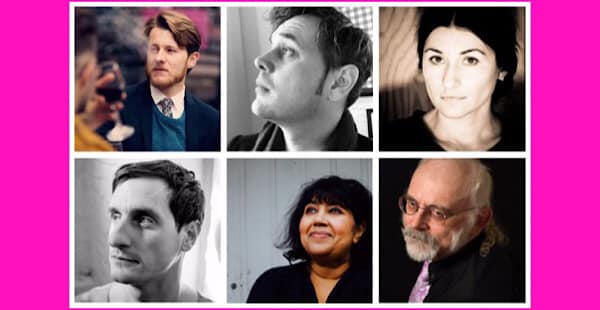
A fantastic lineup of poets awaits – Luke Kennard, Jess Mookherjee, Thomas Stewart, Peter Daniels, David Turner and Maria Stadnicka.

There will also be open mic slots.

The event is entirely FREE and there will be open mic slots.

Come, drink, bring friends, enjoy!

Seeds of Melancholia

2020 catches me off guard. I finish a glass of red wine and start my list of New Year resolutions brushing my teeth. My dentist suggested it, to prevent staining. Spitting paste foam in the sink I notice my second watch shows one past midnight. British time. On the other wrist, my first watch shows one past two. The time in the country I grew up. Youngsters already pissed pints on street corners, on the way home after celebratory fireworks. The end of a decade and all I’m thinking about is how lonely must have been for Ian Seed to share a hotel room with a woman he’d never met. And all due to a booking error.

© Maria Stadnicka 2020


! Recommended reading: Seed, I. (2018) New York Hotel, Bristol: Shearsman Books.  [TSL Book of the Year 2018]


Gallery

Edinburgh 2019

This slideshow requires JavaScript.

© Maria Stadnicka, November 2019.

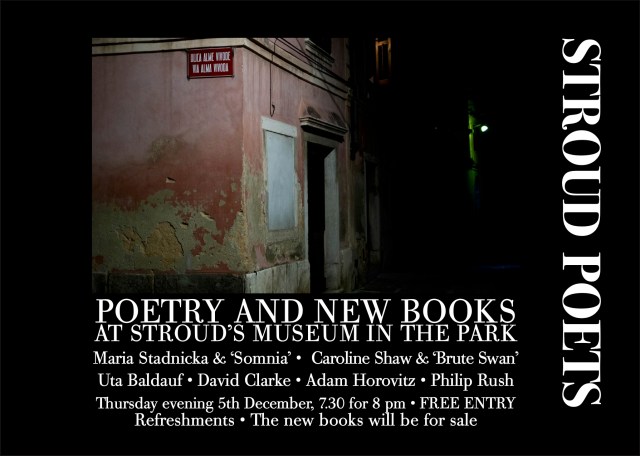
Somnia launch in Stroud / 5th December 8pm / Museum in the Park

SOMNIA Knives, Forks, Spoons Press / Sep. 2019

About SOMNIA:

Writer Ian Seed (author of New York Hotel, a TSL Book of the Year) wrote: ‘one of the best books of poetry I’ve read this year is Maria Stadnicka’s extraordinarily vivid collection, Somnia.’

‘Stadnicka’s poetics is one of craftmanship, wherein she carefully walks the tightrope of surreal poetic metaphor and the gritty realism of investigative journalism and broadcasting.’ (Briony Hughes, writer and critic, Stride Magazine, October 2019)

‘Somnia is consistently alluring and enigmatic in its poetic voice. What compels it’s Stadnicka’s calm creativity in conveying the horrors and/or abstractions of these – her poetic voice completely comfortable in its suggestiveness: inventive, provoking, highly visual.’ (Mike Ferguson, writer and critic, International Times, September 2019)

Somnia will be launched on 5th December 2019, 8pm. Free entry.

Publisher: Knives, Forks and Spoons Press.

Editor: Alec Newman

Cover artwork: Mark Mawer


November, 2019


…where once was a meadow…

This slideshow requires JavaScript.

Photographs: © Maria Stadnicka, Stonehouse, 2019

The SHIFT Project / 12th – 16th Oct / St. Laurence Church


This slideshow requires JavaScript.

The SHIFT Project started with an art installation created by the young Tasmanian artist Robin Watkins-Davies. It developed in a set of events taking place 12th-16th Oct 2019 at St. Laurence Church, Stroud, which bring together contemporary art, music, dance, exhibitions, workshops, presentations, poetry. It supports young people’s mental health, bringing awareness of the artistic potential of our movement. Further details about SHIFT and the oncoming events here.

Maria Stadnicka, October 2019