Questionings, rememberings and imaginings by Rupert Loydell

Imperfect, Maria Stadnicka (52pp, Yew Tree Press)

http://www.yewtreepress.co.uk/Yew_Tree_Press/books.html

https://www.amazon.co.uk/Imperfect-Maria-Stadnicka/dp/095620385X/ref=sr_1_1?ie=UTF8&qid=1497303213&sr=8-1&keywords=maria+stadnicka

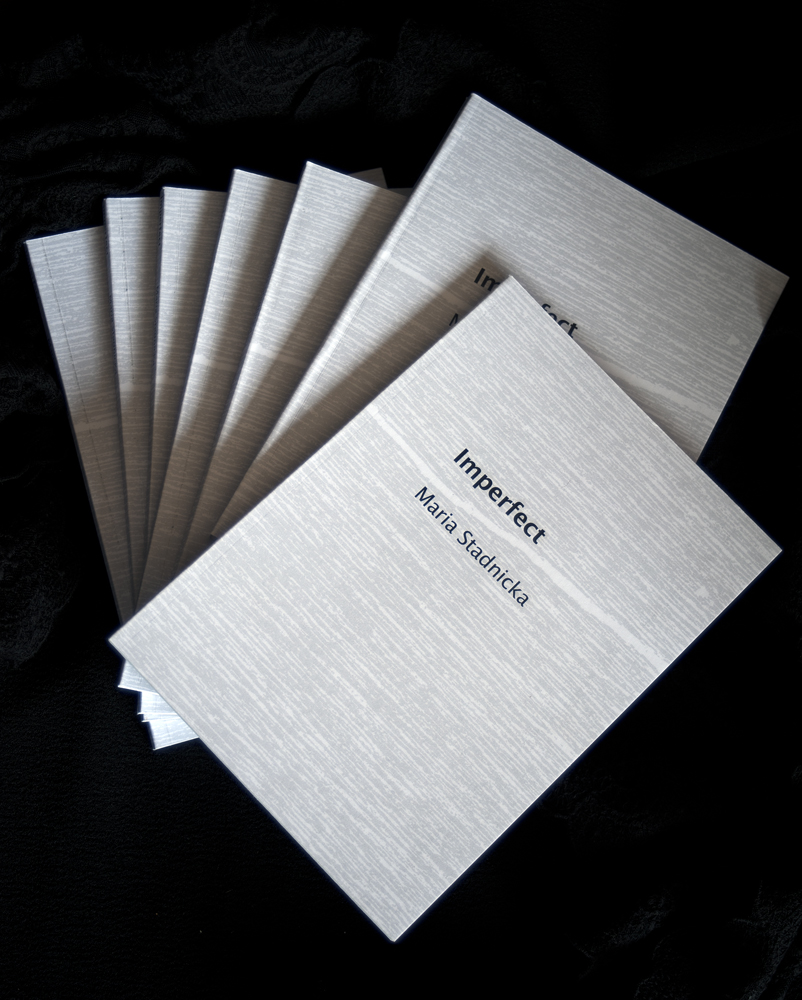
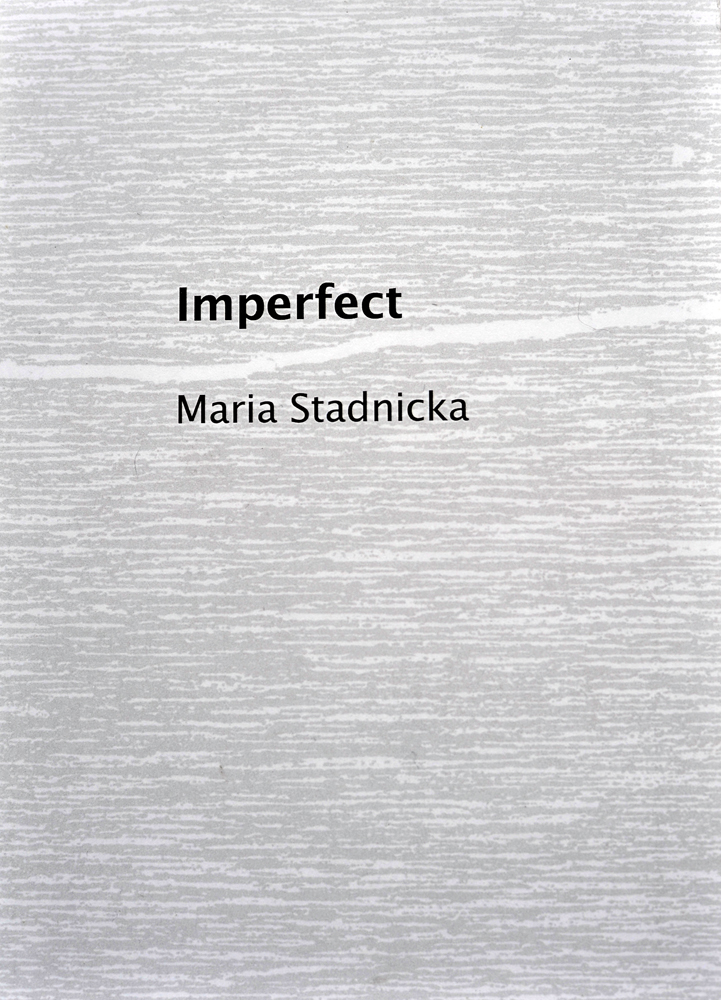
The simple grey and black cover of this book –texture perhaps taken from a tree or wall, with a white crack or line separating author’s name and book title – is in many ways apt for what the reader find inside: a collection of beguiling, uneasy poems that probe ideas of love, politics and human experience.

The work reminds me of Charles Simic’s and Yannis Ritsos’ poetry (I don’t mean it is derivative), and also the gentler end of Vaska Popa’s work. There is the same clarity of images and voice with little metaphor or allusion. Instead a kind of surrealism is at work in the direction the narratives take, in the thought processes being evidenced with their jumps and asides, their sometimes awkward and surprising conclusions. In ‘Settlement’ the narrator has ‘no further questions’ for God, so instead offers him a ham sandwich; in ‘Bad Luck’ the poem moves from a fall through Googled medical self-assessment to burns and then self-immolation, but even as the house burns a neighbour pops in to talk about the weather and running out of tea bags. In ‘Good Bye Then’ Clara’s ‘giggle melted in a slice of bread’.

As Jay Ramsay points out in his back cover blurb, in many ways this poetry is ‘other’. This may be because of Stadnicka’s experiences growing up in Romania, the effect on her of the Cold War, a slight awkwardness in the details of English (e.g. ‘Good Bye Then’ or ‘it stopped me / understand the real life’) or simply her poetics. Whatever, Stadnicka has now found a home in Stroud, in language, and clings on to a hope that underpins the poems, even if this is belied by poems like ‘The Calais Sea’, where

After weeks and weeks of travels,

for the last time, I put my bags down.

I am done with hope.

The lingering tragedy

of what I could be if

we had the right words for tomorrow.

Elsewhere, in a world of inevitable death, madness, broken families, soldiers, barbaric politics and dehumanization, even when there are ‘no other survivors’, ‘even without a language’, Stadnicka defiantly demands that she ‘go on / being allowed to hope’. And does.

This an exciting and urgent first book of poems, that gives me hope for contemporary poetry. I look forward to the next instalment of Maria Stadnicka’s questionings, rememberings and imaginings.

Copyright: Rupert Loydell 2017

http://stridemagazine.blogspot.co.uk/#!/2017/06/questionings-rememberings-and-imaginings.html

A Thing for Poetry, with David Clarke

Last month, I was delighted to attend the launch of a new book of poems by Maria Stadnicka, a Romanian-born poet living and working in Stroud. Before coming to the UK in 2003, Maria worked as a radio and TV broadcaster, presenter and radio editor. She also won a series of national poetry prizes. In 2010 she became member of the Stroud Writers Group, Gloucestershire.

I first become aware of Maria’s poetry when Yew Tree Press published her beautifully illustrated short collection A Short Story about War (as Maria Butunoi) in 2014 and her new poems, collected in Imperfect (also Yew Tree Press), are a welcome addition to her English-language work. Maria’s poems are restrained and precisely crafted miniatures: enigmatic narratives shot through with dark humour and surreal detail, they are eminently political, but rarely tackle Politics (with a capital P) head on. In all of these respects, they put me in mind of the work of Greek poet Yannis Ritsos, yet there also seem to me to be echoes of Kafka: the poems record fragile surface realities, beneath which lurk the symptoms of violence and oppression. This is a poetry of unease, and all the more honest for that, but also ultimately a poetry of hope, recording the struggle of the subject to maintain its integrity in troubled times.

Maria has agreed to feature as my guest poet in this post, which presents here poem ‘City’. Of the poem, Maria writes:

‘What can I know?’….’What can I know?’…This is not my question. Immanuel Kant answered it already, a long time ago, and many other thinkers answered it in their own way too. As a society, we slowly learnt to get used to ‘knowing’ everything a priori. When there is no obvious difference between ‘freedom’ and ‘dogma’, what is the point in asking? Everything is ‘google-able’, right?

Happy to be given the answer, happy to steer clear of uncomfortable dirt and pain. Happy and safe. But isn’t that called oppression?

Recently I have been thinking about oppression and the subtle nuances revealed by urbanism. The layers and layers of conformity which are impossible to eradicate without consequences. But then… how else shall we build consensus?

And one afternoon, walking through my working class town, out of the blue an answer kept staring me in the face. There was the rain and the shops closing at 5 o’clock and people hurrying to get the dinner ready. There was an English February, defined by our sleepwalking hyperreality. Me and everybody else: surrendered, crushed.


City

This afternoon we passed the city prison walls
fighting the wintry wind with a broken umbrella.

It was precisely five o’clock and
a girl on a bicycle overtook an old man
holding a rope.
About the same time,
the ice cream van closed.

The armed police arrived
to disperse the queue with tear-gas.

In the near distance, people ran
between horizontal watermarks
back to their semi-detached
airing cupboards.

We had nothing to stop for and then, I think,
I paused and
I covered my arms with a piece of history.

Imperfect can be purchased by contacting Yew Tree Press (philipalrush[at]googlemail.com) or via Amazon.

David Clarke, poet, thinker and critic. http://athingforpoetry.blogspot.co.uk/p/david-clarke.html

‘Imperfect’ is now available ….


This slideshow requires JavaScript.

This is it. The book is done, the summer arrived. ‘Imperfect’ is published by Yew Tree Press, Philip Rush, Stroud, Gloucestershire, UK and printed by Andrew Morrison, Stroud, UK. Price: £10 with free P&P.

http://www.artistsbooksonline.co.uk/andrew_morrison.shtml

Curator: Jay Ramsay

Photography: @Joss Beeley

Please order the book at mariastadnicka@yahoo.co.uk


This morning….’Shutter Speed’ in ‘International Times’

This morning…a new text in ‘International Times’

http://internationaltimes.it/shutter-speed/


Illustration: @Nick Victor

Image

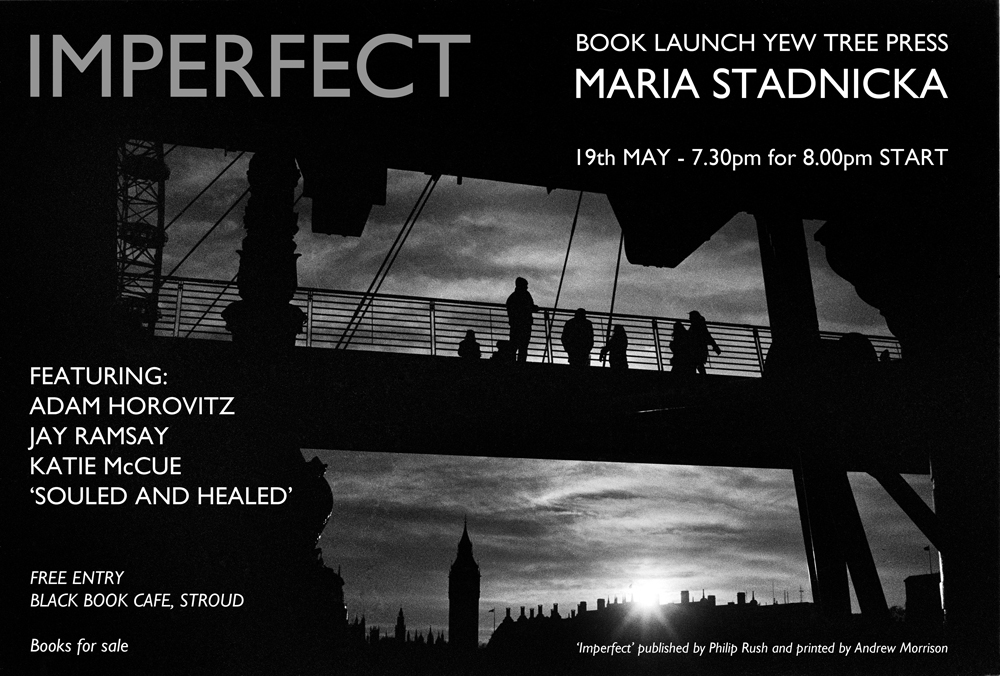
You are cordially invited…19th May, 8pm, ‘Imperfect’ – book launch – published by Yew Tree Press, Stroud, Gloucestershire

Image

‘Good on Paper’, May, MMXVII, Stroud, by Anna Bailey

International Times and ‘Imperfect’…pre-election dossier, 19th May 2017

The box arrived. The first books now being sent to the British Library. And, in the middle of it, a new poem published this morning in ‘International Times’ – the newspaper of resistance.

‘A Day at the Office’ – pre-election dossier.

A Day at the Office


White Breakfast

It was, after all, a beautiful day.

Your hands, resting on the white tablecloth,

the lost sheep in a perfect desert with no compass.

You passed me the tea, I took the newspaper and

arranged my dress in a neat knot on my lap,

smiled and looked the sun in the eye.


The fresh air suffocated us.

The summer, gone.


‘Too much beauty’ I thought to say before I slowly placed the cup in front of me,

‘too much of you’

but I kept a symmetrical distance between my toes and yours.

I stood up and went to the other side of the room

to watch you watching the sea.


On the floor, the breakfast crumbs.

Memory of my passing.

Photograph: @Maria Stadnicka, Lines’, Stroud

Uranium Bullets

I always arrive late for everything.

Stuck in a traffic jam by the docks,

missed Noah’s boat but

survived under water

accidentally trapped between stolen books,

trapped by a word heavier than a stone,

lighter than a feather.


Hidden in the overcrowded wooden train carriage,

radicalised by the anonymity of my blue name-tag,

with a heart growing outside my body.

Each beat painfully visible to the guards

around the Monopoly table.


On the waiting list for ballet lessons,

radicalised by the price of uranium bullets on Mother’s Day

handwriting an apologetic note.

My deep eye silenced.

The familiar solemnity of a world without a face.

Photograph: @John Stadnicki, Bristol MMXVI

Thought

Just before midnight, in the unpreventable moment

my mother woke up to give birth to me,

I jumped out and spilt her blood on the floor.


My first angry poem, scream at the top of my lungs,

in the pale room.


A dormant city blessed the muddy wreath above the cradle

and

asked me to keep the noise down.


Mother went back to bed.


The following day I learnt to

write on white walls with red letters.