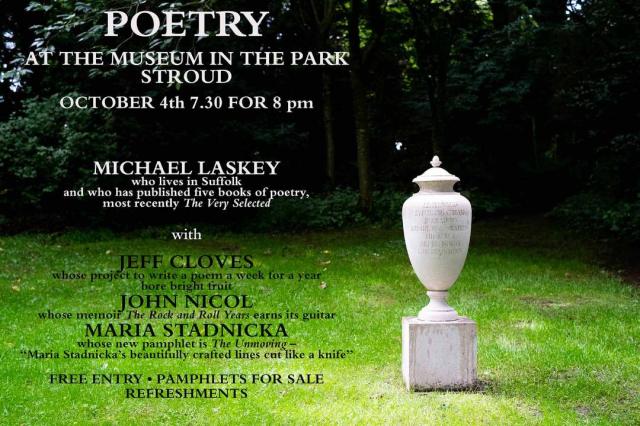
Stroud Book Festival Poetry Night, 9th November, 7.30pm

The Stroud Book Festival is thrilled to once again be hosting an eclectic line-up of poets and poetry from Gloucestershire and beyond.

The first poet on the bill is multi-award-winning poet and broadcaster, Daljit Nagra, on Thursday 8th November at Wycliffe College, one of the festival’s splendid sponsors. Nagra, who was the first ever poet in residence at BBC Radio 4, will be reading from his latest book, ‘British Museum’, as well as earlier books, including the Forward Prize-winning ‘Yes We Have Coming to Dover!’

“He’s a marvellous reader of his work,” says Adam Horovitz, who will be introducing him on the night, “and his questing, questioning, witty and politically pertinent poems are well worth discovering aloud as well as on the page.”

On Friday 9th November, the Stroud Book festival Poetry Night offers up a wonderfully varied and immersive evening of readings, performance and music by a hand-picked bill of acclaimed poets, in two parts.

The first part brings together three poets with Gloucestershire connections: Kate Carruthers Thomas, Patrick Mackie and Maria Stadnicka. It closes with acclaimed Welsh poet and singer Paul Henry and will be compered by Adam Horovitz.

“On Saturday 10th November we’ll be celebrating the work of Gloucestershire poet and composer Ivor Gurney with a one-woman show starring writer and actor Jan Carey, to mark the 100th anniversary of the end of World War One,” says the festival’s artistic director Caroline Sanderson. “Author, Composer, Soldier-of-a-sort: The Life and Work of Ivor Gurney is fresh from an acclaimed run at the Edinburgh Fringe this summer and we are delighted to bring the show to Stroud.

“We round off our poetry programme on Sunday 11th November with a magical family event inspired by nature,” adds Caroline. “We hope that children of all ages will come and meet Frann Preston Gannon, illustrator of the poetry anthology I-am-the-seed-that-grew-the-tree.

“It’s a glorious new gift anthology of 365 nature poems for children, spanning over 400 years of poetry, and including the work of poets as diverse as William Blake, Roger McGough, Carol Ann Duffy, John Agard, Eleanor Farjeon and William Wordsworth. As well as a chance to enjoy the poetry-telling, Frann will be encouraging children aged 6 and above to create and illustrate their very own nature poem.”

How to book tickets:

In person: at The Subscription Rooms, Stroud

By phone: by calling 01453 760900

Online at https://stroudbookfestival.org.uk

Hollow Wean


Dear Sir,

a beauty company sent me an email,

‘We win, you win’ it said, invited me

to purchase youth serum at half price.

There is something I hate about emails

sitting black on white on screen:

comma after verb easily mistaken for

philosophical pause or breath taken

when reading poems aloud.

‘Please, do not reply’

it carried on ‘we hope to see you again.’

I have a hundred things to do but

rush to the bathroom to see how deep

the line cutting my glabellar region

has grown since I last checked.

A fair amount I notice. Others joined

the frontal network, showing people

how much I’ve won in forty years

of living too small, dreaming too big.


©Maria Stadnicka, 2018


Minor Voice

Photograph: ‘Air – 2018’, ©JStadnicki, 2018


to Robin Wheeler

…………………………………………

I saw a man leaving a water glass

at a junction where the elm tree,

he used to know,

had been suddenly cut down.

…………………………………………

©Maria Stadnicka, 2018


Poetics

©International Times, 2018


I had a disagreement with a poetry master
about wolves. And talking made me think
that I, too, had the same great fear
of living forever, but said nothing.

I remained held up by my feet and a tree
came out of my mouth. It hurt badly.
More than a lost war, more than lies.

The poet moved to the left, locked himself
in a room with many doors but no handles.
Outside, his wolf guarded meat-eating days.

Mine wanted to jump from a cloud
straight into the blank page, but waited.
A child passed by and said to me
that wolves did not exist on paper. Only in flesh.

Text published in ‘International Times.’

©Maria Stadnicka, 2018

Image

New Poetry Season / The Museum in the Park

Carrying the World

A chisel, a hammer, a lyre; reportage, intimate feelings, quips and criticisms. Maria Stadnicka’s poems are clusters of consciousness, graphic, material images of our world. Her language assaults, bends, cajoles, thrusts a saber into the darkness of the very language she employs to explore death, degradation, the non-recognition of the human individual, war, urban violence, in short, the all-too-present context of our daily lives. Is there an element of grace, a lyrical thread, an invocation of human beauty? Yes, if one can continue to believe in this beauty while contemplating the profound alienation and marginalization that characterizes contemporary Western societies.

Although Stadnicka writes in English, her native language, Romanian, is always close to the surface of the words, forging and sculpting the associations that create the poems’ presence. Her language mirrors the human mind, elliptical at times, obsessional from time to time, fragile and reflective when the moments present themselves. ‘A moon of salt unravels / the shadow between years, / unfolding a passage / grey chapter about mortality’ offers a lyrical entrance to the book. The reader moves swiftly into the core of Stadnicka’s vision, ‘the wounds of freedom’.

One of the most beautiful poems in the book is ‘Restituto’. Transformation of thought and body occurs as the voice of the poem articulates the ars poetica, an incendiary gesture born out of an already-condemned historical contex:

I covered my face with black ink
rounded all my possessions up
set fire to everything.

The gods hid in a poem
with a fresh loaf.

Just us now slicing away
to the end of my days.

What concerns Maria Stadnicka? How do these strangely forced collages that are hermetic and yet entirely exposed allow the reader entrance to her world? She is speaking about the discontinuity of personal space and the intrusion of economic and political forces in an individual’s life that leads to fragmentation and, ultimately, to the dissolution of one’s reality. The chance for the existence of a future or even the future is removed. Literature becomes the communication and solidarity that permit the step towards wholeness. In Stadnicka’s poems social, personal, and literary landscapes are fused and at times must be forcibly dislocated, both repositioned and torn apart, so that one can continue. The reader is drawn to the quote from Czeslaw Milosz that frames the book: ‘So much guilt behind them and such beauty!’

The title poem, ‘The Unmoving’, dislocates the predictability of images and pulls together the motifs of Stadnicka’s poetry. A book slips, the world is seen as ‘a time-capsule sent flying into space’, a missile wakes the ‘half-dreaming’ narrator, someone is walking down the motorway, people materialize with a dog for sale, ‘The music absorbed what was left of Rana Plaza’ and the reader is once again confronted with the Savor Building collapse that killed 1,134 people in Bangladesh. The narrator is displaced and ‘The ground settled between reference points.’

In a sense, The Unmoving is a defense of the marginalized, the poor, the displaced and disabled. The poems create a sense of urgency and mystery. The only escape from the imposed absolute of non-being is resolution to go forward illogically and irrationally free. ‘For the first time, I / walked. Blind, absent. / I became tomorrow.’

@Andrea Moorhead, 2018

Review published in ‘Stride Magazine’.

‘The Unmoving’ is available here.

Gallery

Economy

Photography: ©JStadnicki, 2018

This slideshow requires JavaScript.

Out next month

The Unmoving is a dark and delicious exploration of post war landscape.

 Maria Stadnicka’s beautifully crafted lines cut like a knife,
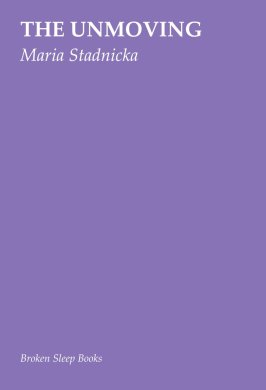
her poems come to the page like water from a deep well, only the well has been poisoned. Masterfully succinct and shrouded in Stadnicka’s trademark sense of mystery,

The Unmoving is as vivid a poetry chapbook as you’re ever likely to read.’ (Broken Sleep Books, 2018)

Image

New collection, coming out 17th August @ Broken Sleep Books

The Politics of Inevitability and the Art Education

Photograph: ©JStadnicki, 2018

There is no way one can observe the social transformations within a community and society without resorting to strong political clues in order to understand the sources of those transformations. And clearly, when things go wrong, we blame the politics, the legislators, the government. But when the political sphere moves away from the reality of the people it represents, the laws and the policies have no real impact on the wide majority. The decision-making groups have little will to support change, and the economic downturn Britain has been experiencing for over a decade seems to move towards a silent collapse. And nobody appears to take responsibility. The blame placed on the government rules like a shadow, hiding underneath the roots of bad financial decisions, personal greed and managerial incompetence.

Let’s consider the situation the art sector is in at the moment.  The issue came into focus with the news of the devastating fire which, this second time, damaged the Glasgow School of Art beyond repair. There you have £35m down the drain, or rather turned to ashes, and everybody is powerlessly looking at the building asking, in disbelief, ‘how could this be possible’. The fate of the Glasgow School of Art seems, for now at least, sealed by confusion and uncertainty. Who is to blame?

Extrapolating the Glasgow tragedy, we are looking for someone or something to blame for the uncertain fate of hundreds of art schools across the country, which slowly, but surely, are decapitated by unachievable targets and percentages. This time, we encounter another type of devastating fire, which is slowly cooking to ashes the art sector, in general, and the art education, in particular: the drive to achieve the funding targets, the attendance and the achievement rates, the literacy and the numeracy benchmarks. What do they all mean? Certainly, they mean nothing to those involved in the art sector (students, artists, writers, musicians, teachers), but mean everything to those in charge to justify the bureaucracy supporting their livelihoods; bureaucracy which satisfies the pleiades of regulators and inspectors. The focus of this type of education is not the youth’s creativity; it is to produce a nation of self-absorbed adults, ready to slot into whatever social square is allocated to them as soon as they join the education system.

And here we face again another type of politics. The ‘politics of inevitability’ as Snyder eloquently describes it, which makes the art education vulnerable and a victim of the constantly expanding globalisation. Since the mid ‘80s, the way we talk about art has fundamentally changed as well as the way the education system works to serve the economy, under the bright colours of neoliberalism.  One would say, what is the problem with that? There is nothing wrong with expecting profitability, and economic success. There is, though, if the principle on which the profit is based, is wrong.

The education and the arts remain essential social institutions  in a healthy society. They create and preserve what we call our ‘decency’. They remain our ‘sane barometer’ if you like, which supports the configuration of our future and the values this future will act upon.

I remember a recent conversation I had with a head of school who recognised that things have taken a turn for the worse, with the Brexit uncertainty looming, but, as he said, ‘what can one do against a whole government, with a mortgage to pay?’

Here we are again, in the blaming game equation. The well-suited head is back in his leather chair, the young artist is back revising for another maths test. New financial cuts are drowning the hope of an economic recovery and the silence of those suffering its effects sounds more and more like a resigned agreement. Not once we feel that the history allows us to see patterns and to understand that action is a possibility.

History permits us, ‘to be responsible; not for everything, but for something’ as the poet Czeslaw Milosz said. This responsibility has always worked against loneliness and indifference.

©Maria Stadnicka, June 2018, Gloucestershire, UK